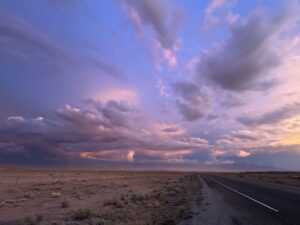
 Afternoon slants toward sundown in the canyonlands of southern Utah. A storm front piles up against the Henry Mountains, painting the sky the colors of a fresh bruise. Wind-driven sand scurries over the pavement.
Hardly anyone is around to see.
Nobody lives on this stretch of Utah 24, which traverses some of the loneliest, most mind-altering real estate in America–a wonderland of sculpted sandstone monuments, broad slickrock flats, corkscrew slot canyons and endless stretches of starving desert scrub.
Since leaving the interstate at Green River 40 miles to the north, I’ve seen fewer than a dozen cars–tourists venturing through the bony desert where Butch Cassidy and the Wild Bunch once hid from the law.
Five miles ahead lies Hanksville (pop. 158) where you can fill your tank and buy a six-pack at Hollow Mountain, a convenience store dynamited out of solid rock. The next gas is 130 miles further south in Mexican Hat, just across the muddy San Juan from Monument Valley.
I’m burning plenty of gas today, returning to Arizona from Wyoming after a visit with my brother, who’s tending a Forest Service cabin this fall in the fragrant, piney Wind River range. And I am reliving my past:
Thirty-five years ago I traveled this route for the first time, eager to inspect this weird, forbidding land up close—at 10 mph, from the seat of a bicycle. It was a tough ride, as I recall.
Up ahead, an odd sight interrupts my memories: a woman walking south, alone. She is not hitchhiking. She is pushing a shopping cart. The thing is burdened with a bulky mountain of stuff–faded nylon suitcase, folding chair, three or four black trash bags crammed full of who-knows-what. On top sits a pint-sized dog that looks like a bratwurst with paws.
As I slow down alongside her, the woman looks straight ahead and gives the cart an extra hard shove. She is around 50, and looks to have been outdoors all season–skin brown and weathered, clothes sun-bleached and fraying, white high-top sneakers smudged with grey.
I roll down my window: “Are you OK? Need anything?” She stops pushing and gives me an exasperated look. “Yeah, I need people to stop videotaping me!”
“That’s not why I pulled over,” I say. “I’ve got water and food if you need it. Or I could give you a lift.”
She softens a little. “I’ve got everything I need. And I don’t think my rig would fit in your camper. Sure could use a Coke, though.”
“Sorry, fresh out.”
“I’m OK. Thanks for stopping.” She gives me a half-smile and trudges on.
I wave goodbye and head for Hollow Mountain, where I pick up a big-gulp Coke. I ask the cashier if she knows about an eccentric local woman with a shopping cart who lives out in the desert.
She shakes her head: “Nope, and I would know, honey. There’s only a hundred and fifty of us here and I know every one of ’em. Besides,” she grins, “there’s no place in Hanksville to get a shopping cart.”
Back up the road the woman is setting up a tent. When I hand her the Coke her face lights up. “God bless you three times over!” she says. “I haven’t had any caffeine in four days, not since Green River!”
We introduce ourselves. Michelle’s dog, appropriately named Tiny, sniffs my ankles. “He likes you!” she says. “That’s a good sign. He’s my best friend.”
In three minutes of talk I learn that Michelle left Denver two months ago, bound for L.A. I do not learn why. I discover that Utah cops are nicer than Colorado cops. And that several times this week drivers have slowed down, stuck their smartphones out the window, then sped away.
“Can you believe it?” she says. “How rude.”
Yes, I can believe it. While on my bicycle trip in 1991 I had beer bottles tossed at me on two occasions. This is not just a Utah thing, of course. To some people, folks who look homeless–or especially odd in any way–are seen as lesser beings, not quite people somehow, and thus subject to different treatment than “the rest of us”.
I think of the vacationers with their videos and am ashamed for my species. I ask Michelle if she’s ready for the storm that’s brewing. “Ready or not, what can ya do?” she says. We both laugh.
I don’t want to overstay my welcome, so I say another goodbye. Back in Hanksville I stop again and consider this woman’s long, lonely journey. What a big deal she made out of a Coca-Cola, what hardships might lie between Hanksville and L.A.
Ten minutes later I am pulling over a third time. The folding chair is propped open next to the tent. The woman is watching lightning flash over the Henrys, shrouded now by the gathering storm. I grin and raise both hands as I step into her camp.
“I don’t mean to invade your space, but this looks like it could be a mean storm. I’ve got this ultralight tarp I don’t really need. It might help keep you dry.” I hand her the folded wad of plastic.
She smiles and waves as I pull away one last time. Rolling into the night toward home, I make a silent wish for her safe passage to L.A. And hope that what she’ll find duct-taped within the folds of plastic will help her to feel just a little less alone in the desert.