 I cinch my camera strap around my wrist and quickly step onto the pine needle path that will take me to the ponds at Kachina Wetlands. It’s the first time I’ve been to Kachina since April, right before I had my hip replacement surgery. I’m looking forward to photographing the wild sunflowers that grow there, realizing that I have more photos of them desiccated in the winter, seed pods empty husks but still beautiful in that dried and dead sort of way.
Even before I walk the path, I realize there aren’t as many sunflowers as I was expecting. I’ve seen this happen before—well-meaning landscapers mowing down hillsides and fields only to stunt the flowers from returning, maybe only growing back a third of what was cut down. After a few years, some of those areas are still barren, dirt replacing the flowers and grasses.
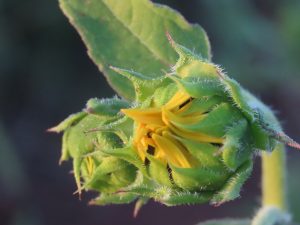
This mowing is not the case at Kachina, though. I’ve simply arrived too early to see the flowers. Instead, I see almost all of the stalks have one or two flowers blooming while surrounded by a riot of buds waiting to bloom. Stepping closer I see ants crawling over the buds, reminding me of the work they used to do on our peonies when we lived in Maryland. As a new gardener, I tried to spray the ants off the buds with a solution of soap and water, not realizing that their love of the buds’ nectar helped the flowers eventually bloom.
These buds are fascinating to me, and I spend most of my time photographing them. My camera helps me see each fine hairy filament growing out of the leaves surrounding each bud. The plants are rife with insects. The ants surround the buds while bees flit from flower to flower and ladybugs hide on the underside of the stems and leaves. My attention vacillates between the wild sunflowers surrounding each pond and the killdeer and ibis slowly picking their way in the shallow water. I have forgotten my tripod and instead rely on the old photographer’s trick of holding my breath to steady my camera.
 I’ve been paying a lot of attention to my breath lately in part because of my return to exercising. My cycling teacher reminds us to breath while we rotate our shoulders away from our ears. In Pilates class, I lay flat on my back on the reformer machine while the instructor reminds me to put my thumbs just below my rib cage to feel my breath. In, expansion of the ribs. Like an umbrella, she tells us. Out, contraction, a gut punch, a tightening of the core.
It seems I’ve been holding my breath longer that I realize. It is easy to remember times when I had to purposefully hold my breath. When the x-ray technician photographed my new hip. When I photographed birds, insects, and flowers at Kachina. But it wasn’t until I watched the sun set, walking backward to catch the remnants of red tinged clouds over the San Francisco Peaks, that I took a deep breath. The air had cooled, and the birds settled for the night. This exhale was more profound than any I had achieved in exercise classes. I let go of something and I refused to inhale it back into me.
 What makes me hold my breath? I know some of the reason is from lingering grief—the absence of my father and my daily concern for my mom. There is active grief as well, looking at the world around me and wondering when people got so cruel. Have they always been this way and I am just now seeing it? Or are things worse than I ever could have imagined? Or is it spread so far and wide that I’m not able to ignore it anymore? I no longer trust my experiences in this regard. There is also the pressure of daily life, not realizing that I am often holding my breath waiting for the unknown and unknowable—the things I can never be prepared for. It starts in the morning checking the news, wondering what terrible things have happened while I slept. It proceeds throughout the day. I used to consider each day an adventure and, as Ralph Waldo Emerson advised me, that I could tuck away each “foolishness” from the day and start fresh tomorrow. It’s how I lived most of my life before I started holding my breath.
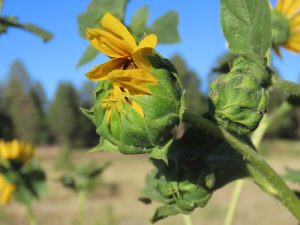
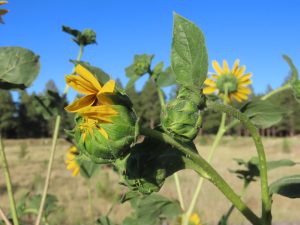
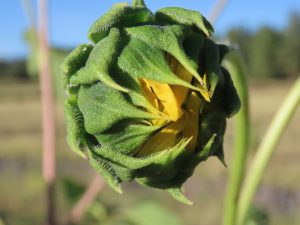 I scan through the wild sunflower images and have captured something that feels hopeful to me. Several of the buds are unfurling the flowers, the sepals half clutching onto the petals. In another few days, the sun and ants will have done their work on the buds, and the flowers will be in full bloom. I can imagine my own unfurling stepping into the rest of the year. An inhale, an exhale, a tilt of my face toward the sun. Eyes closed, not imagining possibilities, but knowing instead that each day I have to keep breathing and to continue breathing into each new day that I’m gifted.