 When the 2008 financial crisis hit, I didn’t lose a thing. There was nothing to lose. No house, no 401K, no stocks or bonds. My minimum-wage job at the bakery still paid minimum. My battered old truck had quit on me, but my bicycle tires still held air. I was doing OK
Nonetheless the Great Recession was a wakeup call. For decades I had been enjoying life, not planning for a future. So at 53–lacking health insurance and dragging around a decades-old student loan–I went looking for a grown-up job.
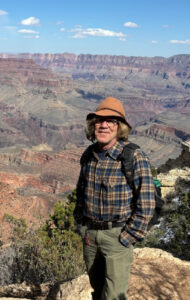
The unemployment rate stood at 9 percent that spring, but to my surprise two opportunities appeared. The one I chose, a career-track job with the National Park Service, came with the usual perks: health and retirement plans, paid holidays, annual furlough for good behavior.
The other possibility? Well, that train left the station without me. Literally.
When I got the Park Service offer I withdrew my application to Amtrak, passing on a good-paying union job as a “service attendant” on what’s left of America’s passenger rail system–one of my very few regrets.
I love trains and always have. A whiff of magic swirls through any train station, any railroad yard, any club car full of strangers who are becoming friends. A diesel-scented aura of freedom and possibility sweetens the air.
As a kid in the sixties I walked the empty tracks that ran through my little hometown back East and daydreamed of starlight on the rails. Train tracks stretched away in all directions, it seemed, under skies drenched with crimson and cobalt and colors I could not yet imagine, toward horizons that only grew bigger and grander the further you went.
While hitchhiking around the country as a teenager I was tempted by open boxcar doors–to stray from the pavement, to go where the tracks took me. But I never did. Today, at 70, it seems doubtful that I will.
(I still could, I suppose, except that boxcars have become obsolete, replaced by soulless “spine cars” and flatbeds double-stacked with locked shipping containers. Also, the cartilage in my joints is thin and brittle, probably not up to the rigors of hobo life.)
But I’ve ridden Amtrak plenty–the Southwest Chief between L.A. and Chicago, the Lakeshore Limited from the Hudson River valley to the Loop, the East Coast lines from Manhattan to D.C. to Miami.
Plenty, but never enough.
So this winter, when Amtrak announced a special half-price promotion of its USARail Pass, I grabbed one. Ten stops in 30 days, anywhere in the U.S., for just $250–a screaming deal, if you have the time to buy in.
I’ll launch my travels next week, sipping coffee in the club car while dawn breaks over the Navajo Rez. I’ll crisscross the country to visit family and friends, and simply to ride–from the Carolina coast to the Oregon coast, from the wheat fields of the upper Midwest to the California mountains and the Mojave Desert.
The train is a civil, communal travel option. On the highway you read billboards and listen to the radio. At the airport, you get X-rayed, frisked and shoehorned into your seat, where you must stay, drawing shallow breaths, until they let you out. Compared to those routines, boarding a long-distance train is like shedding a pair of too-tight shoes.
To ride a train in our frantic century is to spend time on a quiet island, a place apart. The pace is slow, the mood relaxed. The islands bear names like the Silver Meteor, the Empire Builder and the Borealis, the Coast Starlight and the California Zephyr.
Travel on Amtrak is a mere shadow of the rich train culture of Forties or Fifties America, but it’s still pretty wonderful. A train takes you to places that can be visited in no other way, into a world where speed is not the point, where people just sit and stare, where strangers still talk to each other.
On a train journey, there is also time to be alone and just think–about what was, what is and what will be. A train ride also gets me wondering about “what it”.
There were good reasons to take the Park Service job, and it worked out well enough for me, but the decision not to work for Amtrak will always whisper of another life that might have been.
That’s how it is. You can’t put down roots in every single town that scrolls past the coach-car window. Forks in the track take you one way, not the other.
We are left to make peace with that, and to wonder occasionally about the way not taken. What if you had turned left instead of taking those two rights? Which were the good decisions, and which the bad? Does it matter? And how would you know?
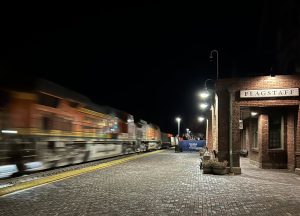
Here in Flagstaff, trains rumble through town all day, every day–mile-long freighters on the BNSF line, the east- and westbound Southwest Chief. Their chrome engines gleam in the Arizona sunshine. The blare of the whistle sings all night.