Oh the water
Oh the water
Oh the water
Let it run all over me…
— Van Morrison, “And It Stoned Me”
A shining ribbon of water flowed through my childhood. On family picnics during the early sixties in Camden, NY, I toddled along the grassy banks of Fish Creek, enchanted as only a child can be.
While my mother grilled hot dogs and dished up potato salad I would gaze at the river in a sort of kid-trance: chrome-green dragonflies zipped to and fro, trout dimpled the water’s glassy skin. The occasional heron hunted the shallows. I would stand and stare, imagining the weightlessness of flight, the miracle of breathing underwater.
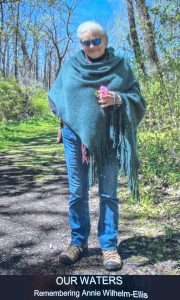
During those years, just a few miles downstream from the place my family called Picnic Point, another child grew up in the sway of those living waters. My late friend, Anna Wilhelm, spent her early life on the outskirts of Camden, a stone’s toss from the west branch of Fish Creek. It cast a spell that lasted a lifetime.
Anna Wilhelm’s story is also my story. Like her, I was a small-town kid who grew up to seek out more politically and culturally liberal places to live, but never stopped loving my conservative hometown.
Like all rural childhoods, ours produced adults who are especially comfortable outdoors:
“Her lifelong passion for walking shorelines…surely began on the banks of beautiful Fish Creek,” Anna’s husband Jim Ellis wrote, after her death three years ago.
In “Our Waters”, a loving and wise tribute to his wife’s memory, Ellis recounts Anna’s childhood by the river–skipping stones, dropping baited hooks, turning over flat rocks to see what lived beneath.
The family home on Trestle Road was an old farmhouse that lacked running water, but gave the young girl constant access to the beauty and mystery of the woods and the creek. Her deep affection for the river – and for her hometown – never died.
Anna Wilhelm-Ellis moved away from Camden soon after graduating high school in 1969, but came back several times a year, always making a stop by Fish Creek at Trestle Road. She and her husband often floated and fished the river.
In some ways Anna never really left Camden. Through the decades she always enjoyed showing off her hometown to the friends she had made living in Rome, Syracuse and Auburn.
“Camden’s impact on Anna is probably impossible to overstate,” Ellis wrote. “…she might complain about it, in a hometown way, but she loved it, warts and all.”
The rural habits and rural values she learned as a small-town girl lasted a lifetime, too, he says: “She admired anyone male or female, who knew how to work hard, had actual real world skills or useful knowledge of some sort, and reliably cared about their families and communities.”
Annie, as many knew her, was such a person herself.
Jim remembers that she always “gravitated to those who treated everyone, even the outsider with respect. She was impressed by such old-fashioned values. They weren’t outmoded to her.”
Annie was also intensely loyal to the people she’d known in her youth, and kept those local friendships alive. The list of her friends that Ellis compiles in “Our Waters” is long. Among them were more than a few exceptional local characters, because as the author put it, “Anna was drawn to the mavericks.”
Which might explain her 40-year friendship with a singular local character named Frank Skinner, a hard-drinking Korean War veteran and everyman’s philosopher 30 years her senior. Annie counted “Skin” as one of her best friends, and took him on bar hops for decades. She was a steady presence during the old man’s final years, and wrote his obituary when he died.
When I read that obit in the local paper in March of 2017, I had no idea that within a few years, cancer would claim my new friend’s life.
Annie and I had only recently become acquainted. She was a few years older than me, and though we each drank in the local hippy bar during the wild and free years of the 1970s, and danced to the same great local bands, we were both north of 60 before our first meeting.
But in some ways we already knew each other, because we had grown up in the same small town. Our lives and personalities had been forever shaped by that place–that home turf, those home waters.
A small-town childhood, like any sort of childhood, has its plusses and minuses. But one undeniable benefit is free access to the natural world–something not to be taken for granted in the 21st century.
Another plus–also hard to find in modern America–is the stability created by a small community’s memory of itself. Many of the people Anna knew and cared about are people that I know and care about. The stories she told are ones that other local folks still tell. In small towns, shared origins ensure this sort of continuity.
So in this way, “Our Waters” is not just about Anna Wilhelm. It’s about anyone who grew up in my hometown–a place where the countryside still looks pretty much as it did 60 years ago. A place where lives and generations inevitably pass, but are never entirely lost, still floating in memory on the waters of home.