 In June the question hangs in the air like virga: When will it rain?
June is upon us. For weeks the relentless northern Arizona sun has poured down on our beloved and beleaguered plateau, sucking moisture from its soils, baking its volcanic rocks and causing we its people to long fervently for rain.
June, the month of virga–those tantalizing purple curtains of rain that sweep down from the sky but are swallowed by the thirsty air just before reaching the parched earth.
June, our season of hope. Despite the inconvenient truths that stack up around us, we look skyward this month and imagine the coming monsoon season. Blessed humidity. Swirling afternoon cloudscapes, lightning shows at night, mornings fresh with rain. Always, we hope for a wet summer.
Winter and spring were dry at my place up near the South Rim. The last real rain came in March. The needle-and-thread grass barely greened up, and bark beetles are chewing on the trees. The threat of wildfire hovers in the air.
It almost rained yesterday, though. A fleet of clouds arrived from the southeast, obscuring the San Francisco Peaks and casting welcome shade over my house. The thermometer read 87. At 2 p.m. it plummeted 15 degrees. A jag of lightning rippled in the pewter-colored sky.
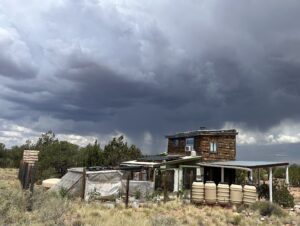
I walked around the yard checking the rain gutters, the white PVC pipes, and the four big plastic tanks–all good. (This matters, because at my off-grid homestead, “god water” is the primary source.)
But yesterday’s clouds could not deliver rain, only the tease. This cycle of hope and disappointment is a fact of life this time of year.
Maybe today, I think, looking up from my beds of squash and tomatoes. The early-afternoon sky looks promising–already darker than yesterday’s. I toss up an offhand, but sincere weather prayer: If it rains, I will be grateful. If not, I’ll be patient.
A half-hour later I quit working at the raised beds and take a seat under the east ramada, next to the lilac bush (which, like most of what’s in my yard, would die without that god water). The air grows still. Thunder grumbles. A light breeze carries the electric smell of ozone. I wait, and hope, and try to be patient.
Another, richer, smell sweeps in on the rising wind–that pleasing odor given off by rain on a hot day. There is a word for it: “petrichor”.
Petrichor results from two reactions triggered by rain: the release of fragrant oils that plants secrete during dry periods, and the production of aromatic compounds by soil bacteria. The word was coined by scientists in the 1960s, and is derived from the Greek petra (stone) and ichor which, in Greek mythology, is the ethereal blood of the gods.
Petrichor has its own effects: it triggers the release of happy chemicals in the human body. The pleasure we take in this scent is probably tied up with our evolution: Rain on the heels of drought has been pleasing members of our species for a very long time.
Finally… it comes.
The first taps on the sheet-metal roof are tentative and uncertain, but the joy compounds are already flooding my system. Once the steady drumming begins I grin, though there’s nobody here to see. The pounding on the metal roof is good news for the tomatoes and squash, for the lilac bush, and for me. It sounds like music. It sounds like a promise.
I step out from under the ramada and listen to water splashing into the tanks. I stand in the rain and breathe. Water pools on the red slickrock driveway. It drips down my face and fogs my glasses. It soaks my shirt and forms a shiny puddle at my feet. It waters my garden and feeds my very soul.