 One summer, years ago, I lived in Washington D.C. while studying American Sign Language at Gallaudet University. Every Friday afternoon, after classes were over, I’d get on the bus and go down to the National Mall where I would wander among the monuments with no particular destination and little purpose except the purpose of trying to discover what it meant to me to be an American. That I might discover such an abstraction there on the National Mall seems only naïve now, but at the time it was a good and honest endeavor.
The monument I returned to over and over, without aiming for it or even being aware of it until I stood in front of its black granite wall, was the Vietnam Veterans Memorial. Something in me needed to run my hands over the names carved in stone. They were not names I knew. But they were young men my age, and something about that made the letters inscribed in the polished granite—the only record I had of their existence—personal. It gave them life by recording their deaths. It always moved me.
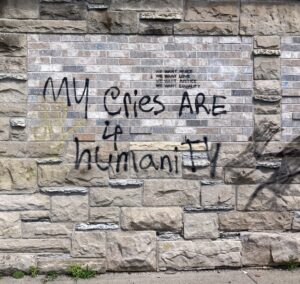
This year, on the Fourth of July, my sister and I went seeking the three memorials created recently by the people of Minneapolis, the city where she lives. At the intersection of East 38th Street and Chicago Avenue lies George Floyd Square. The square is at least a block long and wide. Outside Unity Foods, formerly Cup Foods where in 2020 George Floyd was killed by police, the community has planted flower gardens. Across the street are more gardens and a huge sculpture of an iron fist, one of several iron fists around the square. The garden’s caretaker is a bespectacled man named Maestro. He grows tomatoes and roses, and beautiful little magenta colored flowers called gomphrena or globe amaranth. People come from all over the world, by car, on foot, on buses, bringing potted plants, and Maestro waters and cares for them. A large bright blue and yellow mural of George Floyd is painted on the side of Unity Foods. There are several other portraits of those who have been killed—Black men from the neighborhood. Spray painted on the side of another building are the words: My cries are 4 humanity.
There is an alive feeling to this place. Unlike the Vietnam Veterans Memorial that so moved me, George Floyd Square is full of energy, full of growing things, alive things, the work of witnesses to suffering who have made it their job to remember. Maestro said, “I told George I’d keep a garden for him, I’d keep it growing.” Perhaps he’d had a long conversation with George Floyd’s spirit, or spoken to him in his dreams, but either way he has kept his promise and made of this memorial something vibrant and living.
Then just last winter the people of Minneapolis needed two more memorials, one for Renee Good and one for Alex Pretti, both killed by federal ICE agents while legally protesting the presence and behavior of those agents on the streets of Minneapolis. Renee Good’s memorial stretches half a block along Portland Avenue near East 34th Street. It’s planted with hundreds of flowers, and people have left stuffed animals as they often do, many of them with notes pinned to their furless bodies. Even though it’s right along the street, it’s quiet. There are signs asking the public not to post pictures to social media, please.
Down the street, on Nicollet Avenue, a woman stands at a makeshift table, trimming the day’s flowers, arranging them in vases. So many flowers! This is Alex Pretti’s memorial. It feels more political than Renee Good’s. There are the same offerings of stuffed animals. There are postcards and artwork and Alex Pretti’s stethoscope. A large sign reads: WE ARE UNDERREACTING. There’s a feeling of action at this memorial, at this shrine, and an unexpected appeal to joy mixed with pathos. Someone has painted a small rock a bright turquoise blue, and written on it in black marker the word “Resist.”
What Alex Pretti, Renee Good and George Floyd share, of course, is their role as catalysts for change. Their memorials are not just the places where they were struck down, but the places from which movements grew. Their deaths started something, focused our diffuse attention, ignited something. Had they lived, you and I would never know their names.
That summer in Washington when my feet carried me time and time again to the Vietnam Veterans Memorial, I was in a way trying to bring lives forth from cold stone. Like Michelangelo’s Prisoners, his unfinished sculptures that give the impression of human form trapped in marble, I wanted to free those soldiers by saying their names aloud, one after the other, column after column, calling forth everything I knew of them, which was only what was written there before me on the monument itself.
The three Minneapolis memorials serve a different purpose. Their presence is a reminder. It calls forth anger and grief and at the same time offers the possibility of comfort and healing—and clarity. On that Fourth of July day, I felt the beginning of an answer to my long-ago question, What does it mean to me to be an American? It’s complicated. It means a willingness to die for an idea, yet do no harm. To believe—to know—that people are created equal, yet inequities flourish. To live the ideals of the Constitution is what it means to me to be an American, but just as American is a pledge to challenge the shadowy places in that document, where it fails those it was designed to protect.
Like the Constitution, many of our national monuments were created to celebrate a founding ideal. They’re symbols of power and influence, as American as apple pie. But the memorials that stir the heart tell a different story. These are our nods to the dead, to the men and women who would go unnoticed but for their names carved in stone, or written in a child’s hand on a piece of paper attached to a teddy bear. What it means to me to be an American is to remember their names. To never forget.