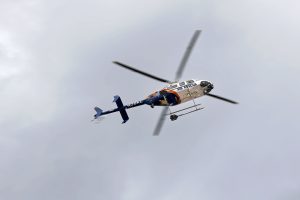
An Arizona Department of Public Safety helicopter flies overhead as a procession escorting fallen DPS trooper-paramedic Hunter Bennett home from Flagstaff to the Valley Feb. 7. Hattie Loper, Arizona Daily Sun, used with permission
The night the police helicopter dropped from the west Flagstaff sky I was lying in bed, trying to get my mind off the disturbing flow of local news updates by immersing myself in a long magazine article. The piece was about Greenland. But it wasn’t one of those articles about Greenland, the ubiquitous kind exploring the politics or the psychology of a rapacious toddler-king seeking to blow up NATO in pursuit of real-estate glory and a compelling plotline in the long-running reality show we’ve all become a part of. No, this story was old-school, an in-depth portrayal of the decline of a traditional hunting culture in an astonishingly remote part of the world. It was a place in which people had been able to survive only because of their amazing hunting chops: stalking seals and polar bears and musk-oxen among steep fjords and over the frozen ocean.
The night the helicopter fell I felt a strong need for something to place my mind’s focus elsewhere precisely because the news was so upsetting: a shooter on the loose in a neighborhood not so far away, and very close to friends’ houses. Running gun battles with police, the motives an entire mystery. The sort of thing that, when it happens in a big-city neighborhood, I shrug my shoulders and think, eh? it’s Phoenix; it’s LA. But now it was terribly near home.
That night I found myself reading about the way the hunters of East Greenland used to travel across ice and snow for weeks on end, pursuing the faint traces of Arctic wildlife on dogsled, living off the land—or ocean—as they went, using up a seal a day as food and fuel for dogs and hunters alike while seeking the higher-value meat of bear or musk ox. They knew the ice, the hunters, and because they lived in a place so far north and so frozen they knew they could rely on it, mostly, and they learned to stay home when it was becoming too broken up, or too softened into slush from below.
Sometimes, one of them made a mistake or got unlucky, and never came home. It was that sort of place, on the edge of what was possible.
That night even after the news came that the shooter had been apprehended I kept digging into the article even though it was very long and even though its very premise was even more depressing than those sorts of recent articles about Greenland, because of course what is happening in the Arctic is that the ice has lost its reliability, it is changing fast due to the warming of the planet, and so even those few local people who still really want to collect their own protein in the wild and have the wild skills needed to train and maintain a skilled dog team and read the signs on the land and take care of themselves in an unforgiving place—even they are finding that the ice underfoot is simply becoming too soft and loose and shaky to support their weight. There was one harrowing story in particular about an expert hunter who found himself with his dog team on ocean ice that was suddenly little more than a slushy crust on the frigid dark water, and he knew that to stop or to turn around was to plunge through and die and so he had to continue to shout his dogs forward, hoping against hope for something more solid ahead.
He found it, and survived. That time around.
That night what I was really in search of was some story that I could take into my sleep instead of what I had been hearing about how the two officers in the helicopter were dead even as the gunman who had started the whole fiasco kept on living and would now probably be locked up for the rest of his life, and above all I was looking for some mental picture that my subconscious could find peace in, and if I hoped at first that maybe it would be an image of a cold and stern and changeless Arctic, with perhaps a single dark-winged falcon gathering itself down in an instant from clear sky to where the sea-ducks gathered below, instead it was turning into an image of ice floes shifting and breaking up and not just a handful of northern hunters but all of us engaging in a desperate dance to find some stability among the chaos.
But that night after the helicopter plunged, sometime in the dark in which borders drop away my mind decided there was no great difference anymore between that image of the ground beneath losing its solidity and the other image I had gone to bed with, because in fact my wife and I happened to have been on our back patio watching the slow and stately flight of the helicopter over our neighborhood and then the mesa when suddenly we saw it yanked down, as it seemed, in a way neither of us had ever seen before, and it disappeared behind the mesa, and I had the lame hope that this unexpected motion reminiscent of a falcon suddenly folding its wings and diving was some super-special helicopter move related to the police chase, but of course the relentless phone soon made it clear that no, that was not it at all, and so all the night long the edge of what is possible seemed far closer than we care to admit.