
 There are times when words fail this writer, and trying to describe the Artemis II mission is one of those times.
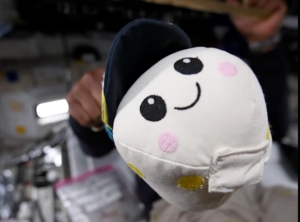
While I missed a lot of the day-to-day mission milestones in real time, I found myself catching up before bed every night. Some of the most striking images were unexpectedly non-moon related—Christina Koch’s braids at zero gravity, a jar of Nutella careening through the small cabin, a small plushie named Rise, and Victor Glover twirling in space. There seemed to be so much joy and goodwill between the astronauts in space and the mission team on earth that it spilled out into our collective consciousness. Finally, some good news. Finally, some hope.
When I think about the mission, it’s the first time in a long time that it felt like we were all included in a monumental human achievement. A lot of it had to do with how relatable both the astronauts and the team in Mission Control were. Somehow, they found time to bring updates, information, and personal observations to social media. It helped us feel connected to the people who were doing the real work and exploration.
At one point, Koch described seeing the earth surrounded by darkness, which gave her the idea of our planet as a kind of lifeboat. That idea has stayed with me as I turn my gaze away from space images to daily life. During the Artemis mission, humans seemed for a brief moment in time to be paddling in the same direction in our vessel. Before then, it seemed that we were paddling in different directions, unable to navigate our way through the flotsam and jetsam of human hubris and cruelty. We’ve lived through times with a collective sense of purpose before, but today I wonder how long this sense of togetherness can last. If I’m short sighted, I see it in terms of…hours, really. One more news cycle and this joy will dissipate, I fear.
But, if I stretch my imagination, I can see the long-lasting inspiration and goodwill of this mission. Last week, I watched my husband set up his own “mission control” in our living room with his two laptops, a smart phone, a tablet, and our television set. He had the privilege of watching the Apollo 8 mission on television as an eight-year-old, which sparked his sense of wonder and curiosity, and eventually led him to study astronomy and become an astrophysicist. He’s been fortunate to do something he loves for over forty years. It gives me hope that the kids who watched the Artemis mission on social media will be inspired to study science and engineering. That it is worthwhile to have passion and curiosity for “nerdy” pursuits.
Seeing these new images of the moon reminds me of all of the conspiracy theories about the original moon landing. There is an inordinate amount of media about how the moon landing was supposedly faked. There are the usual questions about how we had that kind of technology in the 1960s, as well as debates about shadows, boot prints, and “testimony” from those who helped plan everything on a Hollywood lot. It’s hard to imagine that these conspiracies persist, but they do.
I wonder if persistence of these beliefs is that, today, it can be hard to imagine that a group of people from different backgrounds and with various talents can have a collective dream and execute it. So much of what we see today feels individualistic and filled with one upmanship and pointless strife. It’s good for each of us to have our own dreams, but when do we dream together anymore? And if we do, what does that look like?
Dreams have stages built on imagination and hard work that are often invisible. Some look like they come together easily, especially when we see results. We can see the success of the Artemis mission—phase 2 is now complete—because we understand what the plan is. And if we were watching closely this past week, we also see all of the people it takes to make an idea come to fruition. Many of the dreams we have don’t necessarily have a clear trajectory or a single focus. If we dream of clean, potable water, we have to work on one stream or river at a time. There is no one cure for cancer; research takes place in many aspects of human anatomy and biology and with small achievements discovered throughout a long period of time. It may feel like the water will never be clean or that cancer will never be cured because we don’t know when these projects will end or if they will ever end.
For now, though, maybe it’s enough to look at the achievements of these humans during this recent mission. The astronauts and mission team often discussed “moon joy,” but I think they helped us see what that joy can look like on earth. We can find joy in highly stressful situations when literally the whole world is watching. There is joy in delicious food, sweet plushies, good friends, and supportive people around us. In working hard and following a dream even if it may only ever be a dream. Of thinking of all humans on the lifeboat of earth, sharing space and resources. We can find joy in togetherness even in the darkness of space.