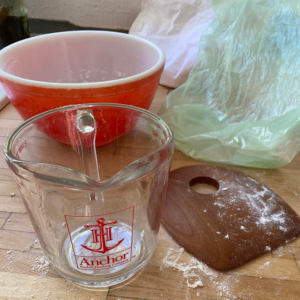
 In the drawer to the left of the kitchen sink here it is, the dough scraper from my dad. Made of cherry wood, polished smooth. The size and shape of a piece of toast. Did he know that one day, though not at the time he gave it to me, I would start making bread? That bread would become a regular winter project? Did I start making bread when I could no longer bear to leave that dough scraper unused, untried, untouched? We remember the giver when gift objects touch our skin.
From my mother I have her wedding desk, a present from her cousin, Roger, on the day she married. I sit at that desk and hear her pen crossing paper, scratching a message on a card—an invitation or a thank-you note or a letter to me after I left home. Audible memories.
When my father died he left behind a dozen calculators and two dozen handkerchiefs—practical tools for the life I lead, and I took several of each. When my mother died I took a wooden box of paperclips. Some other small objects as well, though now they have melted into my life so completely I can’t remember what they are. They are here somewhere but don’t show themselves. They have already found their place in my life. What are these things, tools, remnants, if not tangible proof of another’s life? As time passes, I need proof less and less, because I become more certain that the proof of my parents’ lives lies in me.
As I write this I’m looking at two photographs, one of my mother, the other of my father. Each of them poses at the top of a swim ladder while the other, I imagine, takes the picture. Mom’s hair is curly, almost frizzy. These photographs were taken on their honeymoon at Lake Louise in Canada, and maybe at that time my mother had what was called back then a permanent wave. A perm, we would say now. Her bathing suit is strapless—a bit daring, sophisticated. She’s coming out of the lake, or going into it. She poses for the camera.
Dad looks like a kid, a teenage boy, a Bobby Kennedy double with thick hair and a goofy smile, striped swim trunks. I notice now for the first time, looking closely at this photograph, that he and I have the same cowlick. His teeth are very white and he’s smiling up at my mother as she takes the picture. They’re in a honeymoon daze and at the very beginning of something that will eventually lead to me.
A dear friend of mine, Ann, who was adopted, mourned the fact that she would never find someone in the world who looked like her. Those were the days when closed adoptions were the norm. She had no information about where she came from, no feeling for her people, until one day, somewhere in the house she grew up in she found a photograph of a woman sitting at a table, laughing. Her head is thrown back. You can almost hear the pitch of her voice and the pleasure she’s found in whatever humorous thing was said or done. It’s the end of a meal, the table is covered with empty plates, and the woman is sitting with friends who are laughing as well. The moment she saw that photograph, Ann said, “There’s my mother.”
Is it a homing instinct that carries us along, burying clues in the objects with which we surround ourselves? The dough scraper. A handful of handkerchiefs. That wooden box and all its paperclips. Are we always calling in family, whatever that means to us?
One year, a particularly difficult year in my mother’s life, I gave her a real present, not just a pair of socks or some drugstore hand lotion I knew she liked. I gave her something I thought might help her. It was a beautiful Tobacco Flower Katsina doll. She was puzzled at first. She was a New Yorker and didn’t know Hopi culture. She’d never visited the Southwest. But some years later, I was with her when she was dying and there it was, the Katsina doll, on the shelf beside her bed where she could see it, and when her eyes were closed, as they often were at the end, she would know it was there. And maybe too it was a reminder of me, her child who was most like her and had troubled her the most. A reminder of how things can sort themselves out as our lives close down and something else opens up.
I was a wanderer for many years, taking pride in the fact that everything I had, every material possession, could fit in the bed of my truck. My truck had a cap on the back and during that time, on rainy nights, I slept back there, squeezed between my comfortable writing chair and a Kawasaki 150. I thought of it as a life of freedom. I could stop anywhere along any road and pull out my chair and place my Olympia typewriter on the tailgate and add a few hundred words to the Great American Novel. Or I could drag out the dirt bike and take off cross-country, advertising myself in a plume of dust.
Freedom indeed. It was well past Jack Kerouac times, but On the Road was ringing in my ears and I’m sure I was reading Zen and the Art of Motorcycle Maintenance. I was a decade older than my parents had been on their honeymoon, those eager young beings climbing out of Lake Louise. They were about to embark on a path of no turning back, the final plunge into responsibility and family, a course antithetical to my kind of freedom. They would never travel lightly again. Yet look at my father! He’s grinning that million dollar grin. And my mother with her movie star looks, her sun-tinted hair. She has more of an idea than he does of what’s to come, including five squalling babies, one of them me.
Early on in my life I was naïve enough to be tempted to take a vow of poverty. I would live with three books, a pair of pruning shears, and one change of clothes. I would have preferred the whole set of the Encyclopedia Britannica but that wasn’t part of the deal. I was living under the illusion that if I had nothing, I would understand more about the something I already was. I would clear a path to knowing myself. Illusion it was, and the places where I could possibly live a life like that were always tied up with one religion or another so it didn’t come to pass. But the instinct lingers still. And then I feel a chill in the air and a loaf of bread coming on, and I reach for the dough scraper, a tool that does the job required of it, simply and without complaint, reminding me of my father. A tool that makes me happy I exist in a world of things.