 I suppose the great majority of Americans in the modern era have grown up in relationship with the interstates. With the exception of those living in extremely urban or extremely rural places, residents of the Lower 48 are seldom truly far from a tie-in to the seemingly endless web of superhighways that ties the country together, with its accompanying membrane of Super 8 motels, super truck stops and tourist traps, and super-sized soda dispensers. Before the World Wide Web, there was the Nationwide Web, approved and funded in the Eisenhower era as a way to ease the pressures of a population growing both in size and in its consumptive desires—and, not incidentally, as a means of more easily moving humans and vehicles in and out of cities were they to be targeted in a Cold War nuclear strike.
For me the endless pavement was thoroughly rooted in suburbia, in the form of the concrete ribbon of I-94 on which my mom drove her small passel of children to a shopping center, or to see her friends who hadn’t made the Baby Boom move out to the suburbs, or, on rare special occasions, to the old German neighborhood where we were able to get Old World treats at Meyer’s Delicatessen. But beyond these destinations I had no sense of how the road went on and on. It was just an extension of the suburban grid, and a convenient way for the town’s dads to disappear every weekday morning on their way to mysterious jobs in the city.
Only slowly did the concrete ribbon’s tie to other places unspool, first as a conduit to summer playgrounds in Michigan. We’d drive by the belching and smelly steel mills and chemical plants that clustered like too-heavy weights at the southern end of Lake Michigan, then curve north into sand-dune country. But there we’d leave the interstate for slower blue highways heading north into conifer forests, small towns with fudge shops, wide sandy beaches. Vacation, it turned out, was best reached on winding two-lane roads.
The way home always bummed me out. Reaching the interstate was more or less synonymous with vacation ending, and a return to school or the humdrum of home. Maybe it was those moments that told me I’d someday hit one of those same wide ribbons of pavement and not look back.
* * *
Like NASA lobbing experimental rockets higher and higher with each launch, my orbit expanded. In college my friend Eric and I, both of us having stayed close to home, took to visiting friends who’d gone to the big state schools: Ann Arbor, Iowa City, Champaign-Urbana. Many of the trips took place at night, sometimes on the spur of the moment: mix tapes in the cassette player, steady blackness outside punctuated by the bright white light placed in seemingly every farmyard along the way, as if the residents needed those lighthouse beams to ward off the terrifying dark. We’d arrive anytime, crashing on a couch, or end up having breakfast and coffee in the early dawn.
The interstate, we learned, obeyed no external clock. One you entered one of its fluorescent-lit gas station shops, or a roadside diner, it was only the cues from your own innards and brain that dictated what to look for, what to eat, rather than any external signal. The highway’s life pumped as steadily as our own eager corpuscles did, and we gloried in the unsleeping nature of both. Once, while visiting my college roommate in Texas, we attended an REM concert in San Antonio and afterwards drove west through the night on I-10 just so that we could camp out in the desert. Darkness, it sometimes seemed, was our primary habitat, and it was the road that gave it meaning.
* * *
Not anymore. These days the headlights seem brighter, the headlights glarier, the truck traffic heavier—at least on I-40, whose unending stream of east-west shipping could lead you to forget there’s a parallel railway whose main and constant job is itself to be a conduit for long-distance containers. When did we come to need, or want, so much stuff? That’s a question for a different time. What I notice these days is that 24/7 as a default mode is a distant memory in my own rearview mirror, and that I’m much happier driving by day than by night.
A couple of weeks ago, though, I had occasion to take a quick there-and-back trip to New Mexico, and found myself on the road again, admiring the full moon coming up big through the haze of prescribed-burn smoke. It was an evocative sight, redolent with the hint that through error and loss and correction we might finally be moving toward a better relationship with fire, and with the forests that surround us. Heading east, I had some of that expansive road-trip feeling: there were new places to go, a few days outside the workaday schedule.
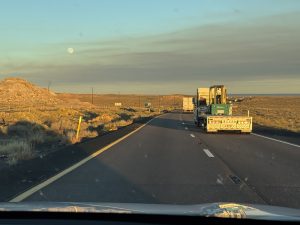
But on the way back it was the highway itself that spelled tedium. Outside Gallup the truck convoys slowed to a crawl at sunset. One of their number, it turned out, had caught fire on the roadside. And at Meteor City the same thing happened again. Traffic slowed, stopped, parked. Eventually emergency vehicles sped by on the shoulder, heading for what turned out to be another semitruck on fire. For 45 minutes no one moved. Home seemed practically in sight, and once it was possible to get there it seemed very sweet.