 The small university where I teach has about 1300 students. We break Hollywood typecasting and look more like a suburban apartment complex than the stately collection of neoclassical buildings favored by filmmakers. Because of our small size, the professors here aren’t grouped by discipline and siloed into separate buildings. We are all together in two buildings of classrooms and offices. So, we have a history professor with an office beside an economics professor and across the hall from a political science professor.
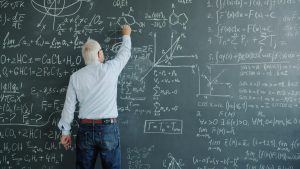
But that random scattering doesn’t apply to the corridor where my office is located. Beside me, across the hall from me, catty corner to me–mathematicians. I am surrounded. I walk by their offices daily on the way to mine, taking in the inscrutable calculations strung across their whiteboards. I hear them in doorjamb conversations using words like isomorphism, topological space and contrapositivity. I struggle to make neighborly small talk, but a crippling feeling of inferiority washes over me, so I resort to bringing chocolates or mandarins from time to time to bribe my way into their good graces. I want them to like me, and I want them to think I’m smart.
Maybe I fear and revere them because I am arithmophobic. And even though I have a lot of company in a lot of countries, I am not mollified.
This introductory paragraph from a 2018 research paper published on the National Institutes for Health website lays it out neatly: “In educational settings, individuals may suffer from specific forms of test and performance anxiety that are connected to a knowledge domain. Unquestionably, the most prominent of these is math anxiety. Math anxiety is a widespread problem for all ages across the globe.”
In grammar school I sailed pretty easily through the fundamentals—addition, multiplication, subtraction, long division. It was in high school and the mandatory algebra class when my arithmophobia introduced itself. When we veered into abstract symbols and operations, my head felt as if it were filled with pudding that blocked the input of any understanding. As my algebra teacher pointed and explained, I became more and more confused. I had been dropped into a foreign country with a language I never knew existed. I barely squeaked out a C- for the class. Until algebra, I was someone who thought that everything I wanted to know I could. But not algebra. Not math. I decided I was bad at it, tucked that belief into myself and sailed on into adulthood.
I don’t want to be this person, this fully functioning adult woman who fears math and feeds into a persistent and diminishing stereotype, but I have been. I’ve read the studies that say arithmophobia tilts toward nurture, not nature. Those studies point to a paltry showing of female STEM role models and the implicit biases of teachers and parents. And while I understand those factors intellectually, I am still trying to unpack the vertigo I feel in the face of a math problem.
Being among the mathematicians has spurred to me think more about my arithmophobia, to consider that math for some has allure and beauty. It was Einstein who likened mathematics to poetry, calling it the poetry of logical ideas. I am thinking more about that, framing math not as impenetrable, but as mysterious (to me) and animated by its own logic.
I still feel my arithmophobia, but I’ve loosened its grip, making space for some awe and curiosity. I am helped with this when I listen to the mathematicians. They talk sometimes about the beauty of mathematics with its structures, patterns, its harmony and its balance. I hear their reverence, their solemnity. And I feel my mind open. Being in their midst might make make this all add up.