We must learn to acknowledge that the creation is full of mystery; we will never entirely understand it. We must abandon arrogance and stand in awe. — Wendell Berry
While much of the planet mourned for Dolly Parton last month, another vital American voice fell silent. Though not a household name, Wendell Berry was as important to the world of letters as Dolly was to the world of music.
Berry, who died two weeks ago at 92, was a farmer-poet whose elegant writing helped to inspire the sustainable-agriculture and local food movements. In a time weighted with confusion and despair (aren’t they all?) his was a voice of reason and hope.
A wildly prolific author, his 50-odd books of essays, verse and fiction celebrate simplicity, rural life and the natural world, and rail against industrialized farming, consumerism and the corporate economy.
Wendell Berry practiced what he preached.
He and his wife, Tanya Amyx Berry, raised a family and subsistence-farmed in central Kentucky for more than 60 years, shunning most modern technology. They used draft horses, not tractors, and owned no TVs, computers or cell phones. Berry wrote with a pencil in a rough cabin that lacked electricity. Tanya prepared manuscripts on a manual typewriter.
I first encountered Berry’s work in 1990, an essay collection called What Are People For? His odes to the simple life and his critiques of runaway technology, militarism and consumer culture hit me like a gust of pure oxygen.
I was living in Manhattan then, feeling trapped in the madness of urban life: the noise, danger and bad air, absurd luxury alongside homelessness, and the lonely feeling of being faceless in a crowd.
As I read, I shared Berry’s heartbreak over the environmental destruction and human misery that seem to be a feature, not a bug, of modernity.
Underlying the ills of the modern world, the author argued, was a fallacy: that economic and technological “progress” came without costs, or that the costs–pollution, destruction of wild lands, the loss of small farms and hollowing-out of small towns–were simply part of doing business.
This, Berry said, was madness.
Berry was also pacifist, quick to point out that those who profit from wars generally do not participate in them: “The most alarming sign of the state of our society now,” he wrote, “is that our leaders have the courage to sacrifice the lives of young people in war, but have not the courage to tell us that we must be less greedy and wasteful.”
“Old-fashioned” values like thrift, generosity and neighborliness were central to his philosophy–and essential to correcting what he saw as the disastrous course we are on.
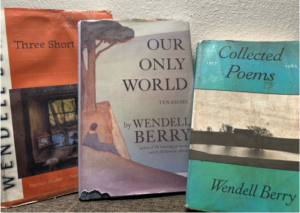
When I picked up other Berry titles–The Unsettling of America, The Gift of Good Land, his Collected Poems–I nodded along at the turn of each page. It all made sense.
The writing is graceful, lucid and spare, the tone often somber and sometimes angry, but laced with hope. Not the consumer’s hope for a better “standard of living,” or the evangelist’s hope for a pleasant and disembodied afterlife, but the practical hope for a good life in tune with the endless cycles of nature.
In order to thrive, he argued, each of us needs to deepen our connection to our place on earth, and to the people and creatures we share it with. saw this as a moral and spiritual duty.
Berry’s Christian faith informs practically everything he wrote, but he was no thundering fundamentalist. He liked to joke that he was a “forest” Christian, who preferred Sunday walks in the woods to church services.
He said the Gospels and the teachings of Jesus were “a burden”–because he took them seriously. He called the destruction of nature “the most horrid blasphemy. It is flinging God’s gifts into His face, as if they were of no worth beyond that assigned to them by our destruction.”
In his writing and lectures, he acknowledge the enormity of the agricultural, ecological and cultural problems we face, but said there was no excuse for giving up. To work against destruction always comes at a cost, he said, but to do so is a bargain at twice the price.
He was not suggesting that everyone become a farmer or a full-time activist, but that each of us become more conscious and allow ourselves to care deeply about the world we claim to love.
To urban dwellers looking for advice on “saving the world”, Berry suggested that they become “responsible eaters,” educated about where their food comes from and how it is produced. How we eat, he said, determines how the world is used.
His books radiate a steady, humane glow that pushes back against the darkness of our times. “Laugh,” he advised, in one of his finest poems. “Laughter is immeasurable. Be joyful though you have considered all the facts.”
In a world tortured by war, want and waste, on a planet that’s cooking in a stew of willful human mistakes, that’s a tall order. Still, Wendell Berry helped to show us a way.