The writing assignment for my second-year university students was an opinion piece. I instructed them to select an issue they genuinely care about so their passion for the subject would animate their work and fuel them through the research and writing.
When I read their submissions, I sifted through the usual topics reflecting Gen Z university student concerns: the call for increased LGBTQ+ rights, the burnout of hustle culture, the unfairness of unpaid internships, and the lousy food in the cafeteria. But Ivan’s piece stood out from the rest. He made a plea for more kindness.
He wrote about being in the United States a few years ago for seasonal work. He and two friends had rented a car for some end-of-summer sightseeing. As he pulled into an interstate toll booth, the attendant told him that the car ahead of him had paid Ivan’s toll in a random act of kindness. Ivan had never heard of such a thing. “It was a small and beautiful surprise,” Ivan wrote. “It made me believe that people can be good to people they don’t know. It made me want to be that way too, to be good to other people even if I don’t know who they are.”
Ivan’s enchantment with kindness reminded me of novelist and creative writing teacher George Saunders. In a recent New York Times interview, Saunders lamented about “the rate at which we are being encouraged to forego human-to-human activity.” He called this the major throughline of his life, saying that human-to-human contact “is really the only thing there is.” In a 2013 graduation speech that went viral, Saunders told students at the University of Syracuse that what he most regrets in his life are his failures of kindness. He urged the students—who were Ivan’s age–toward more kindness even when they find it difficult to muster. “What we really want, in our hearts, is to be less selfish, more aware of what’s actually happening in the present moment, more open, and more loving,” Saunders said.
Giving up a seat on the bus, holding a door open, offering to help someone struggling with a burden—these small acts of human-to-human activity suffused with consideration and generosity are what I grew up thinking of as good manners, the social situation playbook that codifies kindness and sprinkles it with courtesy. These days, widespread good manners appear to have fallen prey to social erosion. The expectation that our leaders will model and embody good manners has withered. But kindness can continue to flower as a gentle and subversive binding agent, stitching us together with tiny, loving threads. Often quiet and sometimes contagious, kindness does not keep score or await applause. To be the recipient of kindness induces a humbling and sacred feeling.
Buddhist teachings talk of loving-kindness toward all sentient beings as a way avenue to enlightenment. Bantu-speaking cultures from southern Africa speak of ubuntu, the notion of the interconnectedness of all people. Kindness as a virtue is held in high esteem in all the world’s religions and is a central theme of the great thinkers. It is in the oxygen of a compassionate world.
I have seen kindness; I have made it. You have seen it; you have made it. Let’s decide to make more of it. We could all use more kindness—random, planned, large or small scale–to help counterbalance our fragmentation. In the context of our current political climate, talk of and ideas about collective emotions tend to focus on the emotional glue of outrage (think Black Lives Matter, No Kings Day). Our angry protests make the news. But quieter solidarities are also afoot. I am suggesting we turn toward those.
In that graduation speech, Saunders, who is 68, theorizes that the older we get, the more likely we are to become kinder. “It might be a simple matter of attrition,” he says. “As we get older, we come to see how useless it is to be selfish–how illogical, really. We come to love other people and are thereby counter-instructed in our own centrality. We get our butts kicked by real life, and people come to our defense, and help us, and we learn that we’re not separate, and don’t want to be.“
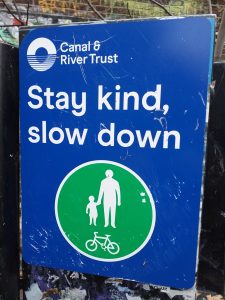
On a recent trip to London, I walked through the northern end of the city on a paved path that runs beside the Regent’s Canal and ends at the Thames. It took a whole day. A light drizzle fell as I passed by the London Zoo, through three city parks and beside low-slung houseboats. I passed joggers, babies in strollers, people cradling to-go coffee cups. I also passed a sign urging us all to be kind and to slow down.
I will comply. Join me.