“The more that you read, the more things you will know. The more that you learn, the more places you’ll go.”
–Dr. Seuss from his book, “I Can Read With My Eyes Shut!”
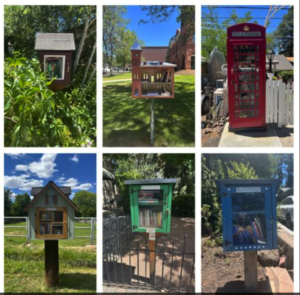 Two weeks ago, I was wending through an unfamiliar Munds Park neighborhood. My map app told me to turn left at the next street. I did. “Your destination is on the right,” it announced, and then I spotted it — a Little Free Library, one of about 85,000 dotted around the country. This one sat on the curb’s edge beside a cluster of recycling bins. It was a royal blue, three-shelf wooden book box resembling a small house. A plaque affixed above the door read: “Take a book. Share a book.” I scanned the spines and saw thrillers, a few Dr. Seuss oldies but goodies and a collection of Mary Oliver poems. I selected the Oliver book, left a book of my own in its place and motored on, my mission accomplished.
That Munds Park Little Free Library (LFL) is one of 32 I’ve visited in central and northern Arizona in the past two months. I’ve sought them out in Flagstaff, Prescott, Kachina Village, Cottonwood, Jerome, Rimrock, Camp Verde, Sedona, Bellemont, Munds Park and Winslow. My stated mission has been a hyperlocal distribution of my latest book, “The Condition My Condition Is In,” which is a collection of essays like this one, published here in Letter From Home over the past 12 years. My secret mission has been to seed little libraries as a gesture of gratitude and to create another connecting point between me and people who love books. Instead of my book being an exercise in commerce, I want it to be a catalyst for community.
Some LFLs are familiar because we spy them in public spaces — the mini-me courthouse little library on the corner of San Francisco and Birch or the bright-yellow book box in front of the Flagstaff Family Food Center. Some are notable because of their freestyle flair, like the two repurposed British phone boxes in front of the home of Daily Sun Chief Photographer Jake Bacon, and their lovechild — a mini phone box of books at the Flagstaff train station. But most follow the LFL traditional format of a small house on a stake. I’ve found LFLs in front of schools, a café, a horse farm, a natural food store and a park, but mostly I’ve seen LFLs standing sentinel on the front lawns of private homes. Some are tricked out with polka dots, garlands, antlers. Some are staked into the ground. Others are cemented into flower pots. Some are accompanied by chairs or benches. Some bear dedications to former teachers and librarians. And all are quiet and welcoming invitations to pause, to linger, to take a book — and perchance to share a love of books.
LFLs are the brainchild of Todd Bol, a social entrepreneur from Minnesota who called them “libraries on a stick.” Looking for a way to honor his mom, who was a teacher and a book lover, Bol used the wood from his garage door to build the first LFL in 2009. He stuck it in his front yard. People stopped. People noticed. Seven years later, Bol and his partner Rick Brooks started a global nonprofit. According to the Little Free Library website, there are more than 200,000 registered book sharing boxes in 128 countries.
In interviews over the years, Bol has cited Andrew Carnegie as an inspiration. Where Bol went little, Carnegie went large. The Scottish-American philanthropist was one of the richest Americans in history and the propulsion behind the U.S. public library movement in the late 19th and early 20th centuries. In the last two decades of his life, Carnegie donated almost 90% of his wealth (the equivalent of $4 billion today) to charities, foundations and universities. He admirably believed that successful capitalists were morally compelled to share their wealth and improve society. According to the Andrew Carnegie Foundation website, 1,789 public and college libraries were funded by his foundation, including libraries in Prescott, Tucson and Phoenix. For me and millions of others, libraries have played a central role in the development of our collective communities and our individual intellects. I see them as temples to learning, aspirational public spaces where we can gather and reach toward our higher selves.
When I was an elementary schoolgirl, a couple of afternoons a week I opted out of our neighborhood car pool ride home and chose to walk. On those days, I stopped by the library. Though it was a building in the realm of the grown-up world, in the library I was a child learning to make her way alone. There were rules, but I was free to make decisions entirely on my own. I could be by myself in a room full of strangers, choose the books I wanted, savor the smell of the paper and ink and participate in solace and shared silence. My childhood was noisy; the library was quiet. In the library I could exhale and drift. It gave me sanctuary and the incomparable company of books.
During these past two months, as I sought and found LFLs in towns and neighborhoods unknown to me, I was beckoned onto the property of strangers, offered a place to pause and a book to take. I was reminded again of what I felt as a child and what I know now as an adult — that books, as author Stephen King says, are a uniquely portable magic.