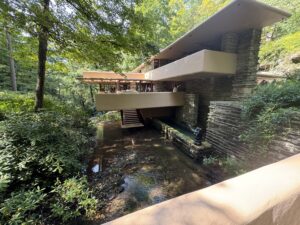
 The calendar read September, but the air was muggy and still when my wife and I had the good fortune this month to visit Fallingwater, Frank Lloyd Wright’s masterpiece of a house that is considered by more than one expert to be one of America’s greatest contributions to world architecture. It’s in Pennsylvania—deeply rural Pennsylvania, that is, where it has for almost 90 years now jutted out over the cascading creek locals call Bear Run.
I’m not sure “jutted out” is really the right wording. When you’re standing on the bridge that’s needed to get you to the house, the structure’s three levels seem to grow very naturally out of the surrounding rock, while the creek flows under the extensive outdoor terraces. Just beside the flowing water is a rectangular pool fed by a spring, an artificial but natural-seeming plunge pool that no doubt served as cool relief on days like this one back when the owners lived there.
Those folks, the Kauffmann family, owned a large department store in Pittsburgh in the first half of the 20th century. They had the money not only to commission one of America’s most famous architects to build this house in the middle of the Great Depression, but also to order up another masterpiece winter house in Palm Springs.
They also, at least as far as we learned from our tour guide, had an enlightened attitude about being wealthy. Before commissioning Fallingwater, Edgar Kauffmann Sr. sent employees of the department store out to a rustic woodland summer camp occupying the same rural site; he believed they needed to get out of heavily polluted Pittsburgh for their physical and mental health. And when after his parents’ death Edgar Kauffmann Jr. was left with the care of their architectural masterpiece, he decided to gift it along with an endowment to a regional conservation organization.
Inside the house, the vibe of midcentury modern design is strong. Wright used clever design to establish relationships between the indoor and outdoor spaces. They are linked by patterns of confinement and release, our guide pointed out: indoor passages or hallways tend to be dim and enclosed, but in passing through them you pop out into light-washed rooms open to intimate woodland scenes outside.
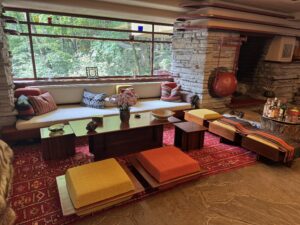 The indoors is necessary, this design pattern seemed to suggest, but the outdoors is essential. It was a 20th-century aesthetic central to Wright’s ideas about what he called “organic architecture,” or building and design that took their cues from the materials, weather patterns, ecology, and other elements of place. Wright saw it as an antidote to the flood of industrialization, standardization, and cheapification that he saw as taking over the country.
No accident that it would have appealed to a wealthy family attracted to what they saw as the healing qualities of nature.
Seen from today’s perspective, much about Fallingwater felt quaint to us. That tray of liquor bottles on a low table by the fireplace: how genteel, how reminiscent of languorous midcentury cocktail hours. The elegant wood shelving full of hardcover books, every single one of them freed of its dustjacket. The tiny kitchen hidden away from the dining area. The pint-sized bedrooms, so unlike what you’d find today in the McMansions favored by many people as economically able as the Kauffmanns were.
But to me the sense of time passed went farther than that, so that as our tour continued I found myself pining for the unrecoverable. Not that midcentury Pittsburgh, or the U.S., or the world, were perfect in any sense: the city was not only terribly polluted but also radically racially divided while Fallingwater was being built and used, the Kauffmanns faced their own societal glass ceiling by virtue of being Jewish, and the Great Depression and worldwide combat against fascism were of epic scale.
But seen in hindsight from our own era of apocalyptic angsts, that past still makes me feel wistful. Imagine the wealthy deliberately doing something to ease the burden of those less economically fortunate, we found ourselves reflecting after the tour. Imagine the wealthy actively conserving land in its more-or-less wild state, thereby giving gifts to posterity.
And imagine, for that matter, the name of the house itself. For Frank Lloyd Wright, Fallingwater was a pleasant and accurate conceit of a name, verbal play pointing to the centrality of Bear Run’s waterfall in the house’s nature. But for us, visiting at the tail end of a summer that will rank with other recent summers as the hottest in all human memory, the word Fallingwater as readily brought to mind disasters like the flash flood that had just occurred in Grand Canyon, killing three hikers and destroying substantial parts of the park’s water pipeline; or the far more disastrous and sudden breakup of a mountain glacier in Tibet that wiped out thousands of lives in the Himalayas.
No doubt Fallingwater the house is on any number of bucket lists, and like quite a few other attractions on such compilations my advice is: see it now. In a climate-changed world with its more energetic atmosphere, its more severe storms, who knows how much bigger a Bear Run flood could become than any that swept through in the 20th century.
Would it be sensible to build a sensitive, “organic” house in a streambed today? Probably not. Would anyone wealthy enough to be able to want such a house, so human-scaled, so sensitive, so lacking in gaudy decoration, so full of bookcases? Perhaps not. Bear Creek murmurs and signs in its gorge. The direction human society is flowing in? Far less certain.