 It must have been 1990 when I encountered the writing of Charles Bowden for the first time, not coincidentally when I first found myself traipsing around the Sonoran Desert in winter and early spring. For a young man from the suburban Midwest the scenery was a revelation: mountains stood like purple cardboard cutouts on dawn horizons, then transformed themselves into textured slopes of bright stone punctuated with saguaro exclamation points. In between creosote flats spread out so broadly that they seemed as much a mental exercise in how distance shapes perspective as a real ecosystem.
But what fascinated me most was how those creosote flats, or the mesquite-and-palo-verde washes, were slammed right up against new subdivisions—or vice versa. In the Midwest, cities sprawled onto farmland. In the Southwest, they sprawled until they reached some arbitrary line separating their stucco walls from what seemed to a newcomer to be wild land, even if stark and mainly inhospitable.
The meeting of the subdivisions and the desert was only the most obvious of the desert land’s many tensions, and for an idealistic young man eager to understand a new place there was no better guide than Bowden, who at the time was making a transition from reporting for Tucson newspapers to writing acclaimed books. He combined a naturalist’s love of place with a reporter’s critical eye and an unhesitating ability to look square at the worst manifestations of life in a boomtown: adulteries, smuggling gambits, real estate swindles, murders.
I loved the complexities and so, obviously, did Bowden. I’d pack his books along on weekend camping trips as I explored the hinterlands around Tucson. Some were mountainous, the wildly crinkled sky islands that hid conifer forests and aspen groves and burbling springs in their rock folds. Some were desert bajadas where twining washes cut through dense stands of saguaros.
But some of the most interesting were those in the borderlands. South of Tucson the land palpably became layered with a sense of history. The ranch houses were older, the broken-down adobes more crumbled. Highway signs along the interstate reeled off distances in kilometers. Radio stations from Mexico came in more clearly as the roads neared the international border which, in those days, was likely to be marked by little more than a dilapidated barbed-wire fence. I can say now that I did on more than one occasion delicately step over a section of drooping wire in order to take a stroll on the other side.
For sheer evocative brassiness, it was hard to beat the drive through the San Rafael Valley, the broad basin west of the Huachuca Mountains. It was the place where the tiny Santa Cruz River, as if to thumb its nose at the idea of human-designated borders, flowed south into Sonora before turning north again to head toward Tucson and the Gila River. It was also the location of an ancient Mexican land grant that had miraculously stayed intact as a single ranch. In the 1990s, a complex conservation deal preserved most of the open grassy landscape against future development.
But not all of it. Hard by the border were the remnants of a straggling little settlement called Lochiel that, by the end of the 20th century, was little more than a few houses strung along a meeting point of dirt roads. True to border form, there were dilapidated buildings on both sides of the border. Old fences and rubble piles showed where others were in various stages of melting back into the earth.
Lochiel was picturesque, no doubt, but what made it more so were the lordly wide-crowned cottonwood trees that presided over the place—a mark of hidden water that showed why humans had decided to build there in the first place. Nearby was a monument commemorating where the first Spanish expedition had entered what is now the American Southwest, back in 1539. But the cottonwoods exceeded it in their monumentality by mutely pointing out that it would be water rather than gold that would determine richness and futures in that Southwest.
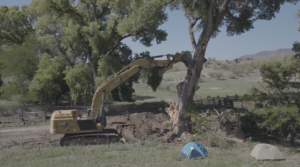
And now I have to write of them in the past tense, because this summer a crew of workers commissioned by our country’s leader came to knock them down, because even in this remote part of border country that sees few illegal border crossers the Trump administration decreed that a giant wall needed to be built. According to media accounts, the wreckage of the trees fell on both sides of the border.
Seen against the backdrop of the global-scale wreckage left by this administration, and by like-minded leaders in other lands, the loss of a few cottonwood trees might seem minor. But the rape of a complex ecological-historical setting, and its eventual replacement by the brutalist gash in the landscape that is the border wall, is worthy of an epitaph. I suggest Bowden words about the pressures facing the Southwest’s endangered species: “the planet,” he wrote, “is becoming a better place for people who hurt their heads when they think.”