 I was, for many years in my family, the Finder of Lost Objects. My mother, especially, had a knack for losing things, and was in the habit of calling upon me to find them. A comb, a telephone number on a slip of paper, the car keys, her wallet, one shoe. I was gone from the house when her engagement ring disappeared, and I possessed no power to find things remotely, which is an entirely different art. My skill was persistence, a dog on a bone, and a belief in the first law of thermodynamics. I closed my ears to the lament, “Oh, it’s not there, I’ve looked there.” I would reply that things often hid under rocks that had already been turned over. Lost objects were either where you had looked or where you hadn’t, and my technique was not to discriminate.
Reuniting seekers with what they seek is what we finders do, or try to. Sometimes I would turn up things that my mother hadn’t seen in years and had wondered about but wasn’t actively seeking at the time, and it would not be considered a victory. The current lost object was still lost. The missing engagement ring never turned up at all and should have been considered a kind of cold case for lost objects, but my mother did something admirable with her loss. After fruitless searching she made up a story about the ring’s whereabouts, a tale she convinced herself of, and this put an end to her wondering. It completed the business for her. She decided my youngest sister, only two or three at the time, had thrown it out the window of our tenth-floor apartment and it had landed on the street. From there it had washed into the gutter and been carried through the drain into the Hudson River.
There is a practical side to finding. It returns useful things to the purpose for which they were created. Keys, credit cards, phones, glasses. Objects of beauty whose purpose is to look beautiful are seldom lost—unless they’re thrown out the window by a child, or stolen, which is an entirely different category of loss. Objects of beauty are often hanging on walls or sitting heavily on mantels, or they’re our gardens firmly rooted in the ground. Objects-most-lost tend to be the ones we carry in our hands and put down somewhere. Tools of every sort are frequently objects-most-lost. Consider the tiny screwdriver used to adjust the arms of our eyeglasses, or the wrenches we keep leaving under the hood of our car. If there is a law here, it is this: As soon as a thing leaves our grasp it is gone.
Buddhism’s First Noble Truth is that suffering exists. You suffer, I suffer, we suffer. It’s a time-tested conjugation. The Second Noble Truth breaks the news that the cause of suffering is our attachments, our desires, our grasping, our habit of holding on. Nothing lasts, nothing is permanent, neither our joys nor our sorrows, and yet we hold on as if our two hands were made to stop the wheels of change.
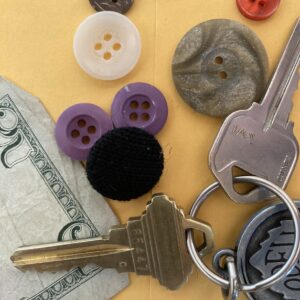
Finding is about reversing loss, and loss implies the disappearance of something once grasped. There are times when things are found that were never lost—by us. A button on the sidewalk, a kitten, a five-dollar bill under the café table. But when we acquire these things and make them ours, when we hold tight to them, suddenly they are objects capable of being lost. Moments ago they flew into our lives quite freely and serendipitously, and would have flown freely away had we not picked them up. We make relationship quickly with objects that come to land on our path. We lean down and claim them and create a situation ripe for loss. We gain and we lose. We lose and we find and lose again. To be the Finder of Lost Objects is an illusion, a mirage, a job made of mirrors endlessly reflecting the shadows and angles of an impermanent world.
If there need be proof that the world is kind, or can be, the Catholic saints seldom disappoint. They are like AED machines in a crowded mall, or the man who carries your groceries to the car. Ready to help and powered by the faith of the implorer, they bring comfort to almost every dilemma. And each of them has their area of competence—such a good idea to spread the wealth of expertise so no single set of shoulders has to bear the weight of the world.
Our saint, the man we need when things go missing, is Saint Anthony. He’s busier than many but it’s rumored he’s highly successful in his field, which is, of course, the field of finding lost things. In addressing Saint Anthony, the proper protocol is to recite the following rhyme:
Saint Anthony, Saint Anthony, please come around.
Something is lost and needs to be found.
Of the man himself we know that he was “short and round and had an attractive personality” and a photographic memory. As a young monk he made his way to Assisi where the Franciscans had set up shop, and there he “spent his days in prayer and served other friars by washing dishes after meals.” A handy one to have around. And when he had time, he found lost stuff.
As soon as a thing leaves our grasp it is gone. As an aging human I am fighting against this truth, a truth I do know to be true. As an aging human I feel wistful. I feel a longing for my years of being a finder as I move into the place of being one who loses. I’ve started keeping a record of things lost, objects like keys, hats, sunglasses, a dog collar, a very nice pair of garden clippers. Soon enough it will be my wallet, and though I hate to imagine it, I may leave the dog in the car or at home without food and water. More thoughts will slip away, more names will be forgotten, but if I can think of a bright side to this it is that each lost thing or thought or memory offers me an experience of relaxing my grip, of opening the hand that grasps. With this may come a little less suffering. Perhaps in the distance it isn’t after all the sound of the angel Gabriel warming up his trumpet, but Simon and Garfunkel singing “Bridge Over Troubled Water.” Sail on, silvergirl….