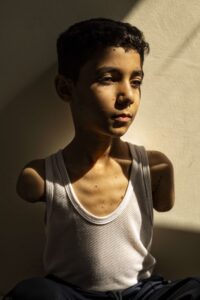
 In our darkened classroom, this striking image of a boy fills the screen. It looms, oversized and mesmerizing. His doleful eyes are downcast. Angular shadows of light stripe the wall behind him. Stubs of what used to be his arms protrude from his T-shirt. Two dozen university students and I are silent as we absorb what we see.
This is nine-year-old Mahmoud Ajjour. The photographer, Samar Abu Elouf, took the picture in Doha, where the boy had been airlifted after losing his arms in March 2024 in an Israeli missile strike on Gaza City. This picture took first prize in the 2025 World Press Photo competition, chosen from a pool of more than 60,000 images submitted by about 4,000 photographers. In today’s Communication, Media and Society class, my students and I click through the contest winners and explore the ethics of viewing images of suffering, catastrophe and injustice.
These days it feels to me as if suffering is omnipresent, catastrophe has magnified and injustice is the new normal.
Billions of pixels congeal into images streaming on the digital platforms where my students spend hours of their time. Though their algorithmic diets include plenty of junk food images (animals, shiny goods, meals, celebs, soft porn travel destinations), photojournalistic images also appear, transporting them to places and people saturated with suffering. I see those images during my morning reading routine of legacy media news sites—faces contorted in pain, bodies mutilated, neighborhoods reduced to rubble, agony radiating from crisis points around the globe.
At times I am numb. At times I am enraged. At times empathy thins my skin and renders the world temporarily unbearable. But beneath all of my emotional responses, the more I see, the more I feel passive, a passivity that is accompanied by shame. Is it ghoulish voyeurism to look at images of suffering if I am unable to do anything about what I see? Do I have a connection—even one that is in the sixth degree of separation—to the suffering captured in the images? Deep down, I feel that the answer to both of those questions is yes.
These thoughts animate my lecture. As we look, I encourage them to ask questions and not rush toward answers: What do we know when we encounter the image? What do we feel? How does this contribute to our understanding of the world? What are we meant to do with what we see? I can hear their minds humming as these questions vibrate and tumble.
We talk about the ideas of cultural critic Susan Sontag, whose writings probed the contours of our responses and responsibilities when we view images of suffering caused by human cruelty. Sontag coolly challenged the idea that viewing images of atrocities provokes our empathy. In her opinion, viewing these images does not necessarily lead to meaningful action. Instead, it often contributes to saturation, numbness and inaction. “Images anesthetize,“ she wrote. “An event known through photographs certainly becomes more real than it would have been if one had never seen the photographs, but after repeated exposure to images, it also becomes less real.”
“Isn’t caring an action?” one student asks. “When I see pictures of people in pain, I care more about their situation and want to know more about it.”
Another student counters. “When I see pictures of people in pain, I feel manipulated. Aren’t we exploiting these people somehow, making them seem less than human and more like a gimmick to get us to feel something?”
Their questions continue as we pivot to the ideas of Ariella Azoulay, another cultural critic. Azoulay says that when we view images of people suffering, we enter into what she calls “a civil contract.” Photographs of suffering and injustice are not solely journalistic evidence or aesthetic records, they are obligations. Her stance hinges on agency and participation. She urges us to watch instead of look.
“The verb ‘to watch’ is usually used for regarding phenomena or moving pictures. It entails dimensions of time and movement that need to be reinscribed in the interpretation of the still photographic image. A viewing of the photograph that reconstructs the photographic situation and allows a reading of the injury on others becomes a civic skill, not an exercise in aesthetic appreciation.”
We click through a few dozen more images, taking in their composition, the stories they are telling and the worlds they have captured and frozen in their frames. As the class winds to a close and the students gather their water bottles and backpacks, I return to the picture of the boy without arms and let it fill the screen as the students leave the room. I linger on it, lost in a mild reverie.
For me, the issues raised by this photo of nine-year-old Mahmoud are not what I see, but what is being asked of me. How can I listen more deeply to the image to hear the questions? And how am I to answer?