 A snapshot: A woman walks down the road outside a small California town. She walks with a swing of her body, a comfortable yet deliberate walk. As I drive by I notice on this December day that she is barefoot. My passenger cries out, “Stop the car! Do you know who that is?” I don’t know who that is. “It’s Joan Baez!”
To my passenger’s dismay I didn’t stop the car that day. Because what does a person say to a voice, a voice so emblematic of a time, a movement and a country trying to find its way? I grew up on Joan Baez. The words freedom and justice were in the air and she sang them out—to those who were marching or sitting at lunch counters or mourning the loss of innocent lives. Her life’s work came to us through her voice. What does anyone say to a voice like that?
I was in high school in the ‘60s, when things started heating up in this country. Or rather, the things that started heating up in the ‘50s came to a boil in the ‘60s and the country had to sit up and take notice. Even if you weren’t around at that time, if that time is ancient history to you, you know the legacy it left. You can sing its legacy. Song is what that time was made of. Song and violence and war, and attempts to offer peaceful solutions to counteract our human tribal instincts, by which I mean our continuous efforts to prove we are separate.
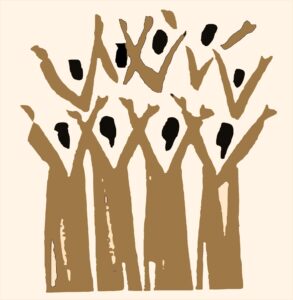
It was all in the songs, and songs were sung not just by singers but by politicians and organizers and activists, and those at the lunch counters who would not be evicted, and those on the buses who would not move to the back. Those who marched, sang. Those who sat down on the ground and refused to assist in their own arrest, sang. In churches, especially the Black churches, people sang. They sang the hymns that had become and would become songs of protest. “We Shall Overcome,” “Amazing Grace,” “Keep Your Eyes on the Prize,” “This Little Light of Mine,” and many more.
Pete Seeger, Woody and Arlo Guthrie, Odetta, Nina Simone. Joan Baez, Bob Dylan, Phil Ochs, Holly Near. Bernice Johnson Reagon, Helen Reddy, Marvin Gaye. These are just the more familiar names, the protest singers I grew up hearing. I couldn’t sing a note, but they sang for me.
The other day a friend sent me a link to “Streets of Minneapolis,” Bruce Springsteen’s protest song about the recent killings and injustices in Minneapolis. It’s a powerful song, and I was moved by it, but what I took away from it was this: I haven’t heard a new protest song in a very long time, a song of this style that speaks to a specific injustice and turns, at the end, towards a promise to remember. A song that can be sung on the streets by a crowd of people, hundreds of people, that leaves us with energy and a sense of connection.
Protest songs have their roots in history. Many of the songs we sang in the ‘60s are songs people sang long before the ‘60s, and if we are singing the same songs, what does that say about the continuity of resistance and cries for justice in a world resistant to change? Humans have historically given voice to change, to revolution, whether in writing or speaking or singing. In the past, literacy and oratory skills weren’t as widespread as they are now, but singing was for everyone. Singing while you worked made the work go more smoothly. Singing in church made God more approachable. Praising your country in an anthem, in song, gave a boost to nationalism. Singing to your children put them to sleep. Revolutionary or protest singing has always been a way of organizing and encouraging a crowd, of sending a unified political message, of taking action.
Here in Flagstaff we’ve been consistent in taking action. Almost every week, crowds great and small gather outside City Hall to put forth their message, whatever that message might be. There’s nothing unlawful about this. Freedom of speech and the right to peaceably assemble are guaranteed by the First Amendment to the Constitution. I’ve been to several of these gatherings and though I do hear chanting, three or four words repeated in call and response, I don’t hear singing, and I wonder why this is so.
In this political moment especially, where are the songs? It may be too dramatic to say I mourn the dearth of them, but there’s truth in that. More accurate may be that the culture has moved on beyond me, and raising our voices together is impossibly old-fashioned. Lending our voices to the moment, to the movement, has always been a great source of energy and connection, and I hope it will continue to be in this relatively new culture of phones and screens and robots. Singing is humanizing. It carries both emotion and restraint. Surrounded by other humans using their voices, singing carries accountability. It’s not a stadium full of fans shouting and out of control; it’s community and focused intention.
Springsteen’s chorus goes like this: “Oh, our Minneapolis, I hear your voice singing through the bloody mist.” On the second chorus he changes the singing to crying, and on the third and last, the city is back to singing again. What a good choice for an ending to a rousing call to action, the action of outrage.