
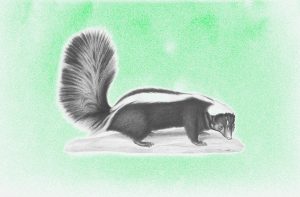
 The guy on the TV screen tells me two things I didn’t know. One, I almost certainly have a skunk under my house because in winter that’s where skunks go, under houses. And two, if I don’t already own a Skunkinator, I need to run out and get one right now.
Salesman he is, but the way he phrases it is more like two of the Four Noble Truths of Buddhism: We suffer; there is an end to suffering. We have a skunk; there is a way to get rid of the skunk. This appeals to me, a kind of esoteric sales pitch designed for those who would like a smattering of religious reference along with their everyday skunk catching. It’s hopeful. All is not lost! The end is near! And while pithy is not often the tactic of someone trying to sell you something you probably don’t need, I can feel myself beginning to bend, to succumb, to need nothing short of a Skunkinator.
I’ve been thinking for the past few weeks that my neighbor has been smoking a boatload of a once-illegal substance and that’s why my home smells a little skunky. But I’m willing now to consider another truth which is: the skunkiness belongs to a skunk. There used to be a cat living in the crawlspace and she kept the skunks away, but she’s moved out of the neighborhood. At this point I’ll take suggestions from anyone when it comes to alleviating the funk—the skunk—in my house.
Having a skunk under your house is like having an overactive conscience. Reminded, reminded, reminded, reminded, every day, all day long. He or she is not an inconsiderate housemate, and unlike many of my housemates of old who left more than occasional dishes in the sink, hair in the shower, and played Jefferson Airplane at an inappropriate volume and time of day, Petunia (as I’ve named her or him) is a skunk. She does not chatter on about bad boyfriends. She doesn’t complain that her thighs are too fat. She lives downstairs and I live up, if you consider the tightest of crawlspaces under my house “downstairs,” and she seems happy with the accommodations. So the reminding, which comes in the form of her malodorous odor, something she is helpless to do anything about—this reminding is an inconvenient lesson in tolerance that I can make peace with, mostly, even if I wish she had made her winter quarters under someone else’s house.
I grew up with a skunk. That may come as a surprise to you, especially if you happen to know I grew up in a small apartment in the heart of New York City. Rats there were aplenty on the streets, as well as dogs on leashes—terriers, Great Danes, every breed imaginable, large or small. Central Park was overrun with squirrels, chipmunks, and probably stray cats liberated from domestic life by their owners when a move to a smaller apartment was made. Raccoons almost certainly fished in the ponds, living a shy, nocturnal life. This leads me to believe skunks were residents of the park as well, and maybe elsewhere in the city; we just didn’t see them out and about while the sun was up.
Our skunk was not an outdoor urban skunk. He was a pet store skunk my father brought home after my younger sister was born. Back then, pet stores sold skunks and other wild animals. They don’t anymore. At the birth of my younger brother, two years earlier, Dad had presented the three of us older kids with a raccoon, Mr. Peepers, who eventually went a little nutty and ended up on the Captain Kangaroo show. Were these gifts of my father’s meant to keep jealousy at bay? And whose jealousy, ours or his? Did he need something new of his own to ease the loss of my mother’s attention? Impossible to say. But I often wonder, had my parents added more kids to the family, what would have come to live with us next?
The taxonomic name for the skunk who shares my house is Mephitis mephitis, meaning double foul odor. Striped skunk is its much kinder common name. Hooded and hog-nosed skunks do show up on the Colorado Plateau, though their home territory has always been farther south. They sport a single wide white stripe, unlike M. mephitis which wears the more classic double stripe. My friend, Tony Hoagland, immortalized the hog-nosed in a poem, calling it “a wig on legs.” Once that image gets in your head, you’ll never see a skunk without thinking of a waddling hairpiece.
The Western spotted skunk, Spilogale gracilis, is a small skunk, around two pounds, with a beautiful pattern of white spots on its little body. The only place I’ve seen these skunks is in Bright Angel Campground where they hide until nightfall in the culverts between the campsites and the main trail. They spray like any other skunk but their warning system is more elaborate. Instead of just lifting their tails to let you know you’re in deep trouble, they take the time to do a little handstand. Up they go on their forepaws, gaining you a few more seconds to scamper away.
Skunks and raccoons, I’ve discovered, are not the only unusual creatures to share our lives and our accommodations. My friend, Elena, grew up with a duck in her family’s small Moscow apartment. An old schoolmate of mine, who lived in a New York City walk-up, shared her bedroom with a monkey. Alligators were said to populate the sewer systems of New York because as pet hatchlings they had escaped down drains and toilets. Ferrets, parrots, songbirds of every stripe, snakes, iguanas, a tegu, an octopus, at least one rooster—these were some of the chosen housemates. Perhaps we humans are drawn to building bridges of understanding between ourselves and other species because we find it so difficult to build those bridges to our own. But how accurate we are in our assessment of those at the far end of the bridge, of whether or not their animal wants and needs can be met in captivity, that’s another question.
As for my skunk, this is how the situation stands. I went to the hardware store to buy a Skunkinator and came back empty-handed. There were live traps galore but not one of them held the promise of the Skunkinator with its straightforward trapping mechanism and tight quarters preventing the animal from spraying while enclosed. So Petunia has renewed her lease for an unknown period of time, and in a spirit of optimism I have rewritten one of the Four Noble Truths, the one that says there’s a way to get rid of the skunk. It now reads: There is a way to liberate the skunk. Because who doesn’t want to be free?