The rime is the reason.
As someone who lives by choice at high elevation, I know the happy truth that those of us who are lucky enough to live up here are simply closer to the sky than most other people. Which according to my dermatologist and eye doctor alike is not always a good thing. But I will take the trade, paid off in fresh air, mountain vistas, nighttime dark skies.
And in the sense that when you live at over a mile high winter is always nearby. Even on a hot summer day it’s up there not that far above us, in some unseen atmospheric layer cold enough to form ice crystals. The Diné name for the mountain that does in fact tower a mile high on the skyline refers to something like “shimmering” or “snow-capped”: Dookó’oslííd. Snow lingering all summer has perhaps become a rarity; but most summers we do still get to see the rocky reaches above treeline glittering now and again with newly fallen hail, a brief benediction of winter, or the sky gods, or both.
Get up high enough, in other words, and you might be able to visit winter in the terrain where it currently chooses to dwell. This is perhaps what lured me up the Elden Lookout Trail earlier this week, during a winter in which the temperatures have been higher than usual, at the tail end of an autumn whose storms delivered their gifts mainly in the form of rain rather than snow.
I should say here that I am not one of those winter fanatics of the sort you meet regularly in a place like ours: the gung-ho skiers, snowboarders, husky walkers. I don’t mind cold weather much, but every year I go through withdrawal pains as the long evenings of summer give way to early darkness. If there is something along with close access to mountains and canyons that drew me long ago to northern Arizona, it is the reliability of the light, the knowledge that most days the skies will be clear, the horizons long. And so the first pangs of dread hit me in October, when sunset catches up to and then begins to precede dinnertime. The next arrive in December, when I usually have to concede that I have to curtail some of my usual activities—like drinking my morning coffee outside—due to both darkness and cold.
But it had gotten to be early January, and there had yet been no reason to pick up a snow shovel. That felt wrong, and far too close to the numerous projections of our climate future—or climate present—that limn how snow gives way to rain as the temperature rises. Winter in many places around the world is endangered, slowly withdrawing higher up into the sky. Because of those projections, and because of our collective heightened awareness of how easily a warmish or dryish winter can give way to a severe fire season, it’s hard to look out the window at January’s bare ground without a sense of impending dread.
So that’s really why I felt a need to go visit winter, preferably on foot. I picked a day when dark billows were snagging on the top of the mountain, ripping their edges only to patch themselves again in that miraculous way clouds have. Among the ponderosa pines, the ground was wet from rain in recent days.
Up the familiar switchbacks, which I’m more accustomed to hiking on sun-blasted summer mornings. This time the sun ducked behind the clouds, then briefly peeped out again. The wind was chill. By the time I got up to the lowest trailside aspens I was able to crunch across remnant crusts of stale and frozen snow.
Snow flurries began to fall. The city streets below looked far away indeed. Facing a stiff wind, I panted up the final switchbacks before the junction with the Sunset Trail. This to me is the reward for climbing Mount Elden—not the windswept summit, which is pockmarked with all kinds of telecommunications infrastructure, but the sweet dwarf aspen grove that spills down the north face of the slope, some of the trunks bent into curls from the weight of snowdrifts in winters past. The presence of aspens on the mountain appears to closely echo where snow lingers the longest, or where winter sun shines the least—and sure enough, here the trail was mainly hidden below crusty mounds of boot-stomped snow.
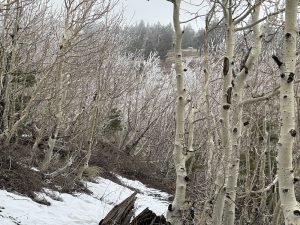
I put spikes on my boots and walked on. Snowflakes were spilling from the steely sky. I knew that where the trail leaves the grove the wind would be fierce, and sure enough as I got there I saw that the aspens there had taken on their own wintry appearance: each one was coated with rime ice from where sleet had been blown in. Every twig and branch sprouted a delicate blade of ice that pointed in the direction of the wind.
It was, without knowing it, what I’d come to see, a onetime expression of how cold and wet can combine to form such sublime constellations of forms. Winter was here, and now I’d have to hustle carefully back along the trail to get down before dark. If I were lucky, I thought—or if we all were lucky—it would come visit us more directly soon.