 Over the past year, I have lived in several homes. Some were house sits, some were borrowed guest rooms. Each had a different layout, a different style of couch, and a different set of rules about how to care for pots and pans, fancier than I could ever afford.
But as the doors revolved, I found myself drawn to rectangles that reassembled my emotional world. For once, straight lines felt more comforting than curves, and rectangles felt oddly restorative.
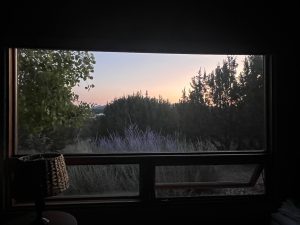
One was on a ranch in the New Mexico desert, a large open window that turned the desert light into a daily ritual. Another was a painting, shadows drifting across a long, rectangular canvas, a frame that felt like a quiet field of moving thought. And a third was in the same house where I slept, a large window above the bed, meant to be kept open, moonlight slipping in and edging the blankets in silver. Sunrise nudging in the corner. It takes a lot for me to relax.
I only noticed the pattern recently.
Architecturally, a window is simple: four right angles, a rectangle. But the rectangle has held meaning far longer than the window has. In ancient Mesopotamia and Egypt, rectangles were used to mark out agricultural fields and formed the basis of the first house plans. The hieroglyph for house in ancient Egyptian writing is a rectangle with a small opening at the front. The rectangle meant shelter, structure, a place where the body could return. It all makes sense in light of what my nervous system needs this year.
Euclid included rectangles in his foundational work on geometry, treating them not as ordinary shapes but as the building blocks of reasoning itself. The rectangle became a means to understand, measure, and stabilize space. A boundary and a container. It contained something when I felt so uncontained.
I did not set out to think about rectangles this year, but wherever we encountered large and wide ones, I drank them in. Once, even a shower window meant something, life, like spring coming to say hello in the mornings.
Edward Hopper understood the rectangle’s quiet force. One sits in front of a dark slab of night, sipping a small cup but facing forward, bringing thought and not just feeling together and tying them off at the corners. Automat.There’s also Woman in the Sun, and Morning Sun. The window in Nighthawks transforms the diner into a kind of aquarium, where people are visible yet sealed in their own membrane atmosphere.
Vilhelm Hammershøi painted windows as muted openings. His rooms feel like the moment before someone says something important.
Matisse opened his rectangles entirely. Open Window, Collioure is not about separation at all. It is the world rushing in. We see color as an invitation, thin enough to breathe through.
I have lived this year between Hopper’s awareness and Matisse’s wanting.
In one house, the window became an excuse to watch the slow shift of late afternoon across the yard. In another, I slept below a window and the moonlight edged the blankets in silver. I found myself drawn to rectangles that were larger than usual. Excessive, even, but still managing the flow of the day in a measured way. Big enough to gulp nature. It was a theatre to me, sometimes of wild wood, often of dry soil. And every so often, rain would lie flat at the window’s edge.
I picked up All Things are Too Small: Essays in Praise of Excess by Becca Rothfield, and I keep it ironically next to my book on minimalism – both found in little free libraries around town.
If I tried to remember this year chronologically, I could not. But I can remember the light in certain places.
Lately, I notice I am having trouble remembering my son’s early childhood, too. I watch old videos and feel something sink. I remember the words, the rhythms, but the textures, his weight against my chest, the ordinary sound of his voice in the morning, feel further away than I want.
A window is a boundary, yes, but a gentle one. The kind that allows closeness without collapse. The type that we aim for now in therapy, in contrast to the over-advertised rigid boundaries that people so pride themselves on. Now they praise instead, an open distance.
Agnes Martin believed repeated shapes could generate calm. A rectangle is one of the oldest rectangles we have. Common. Unremarkable. Easy to overlook.
They were so dull, then.
But sometimes what restores us is not dramatic. Holy mother of rectangles.
I did not know I needed you until I did.
We watched At Eternity’s Gate yesterday. I was drawn to the idea that Van Gogh believed a painting needed to happen all at once. Grief isn’t like that; it is much more like breathing, something we wish had edges that ended it.