 Sometimes a long walk is in order, not least for those who make a habit of inquiring about humanity’s proper place in the world. “This is my master’s library, where he keeps his books, but his study is out of doors,” William Wordsworth’s servant is supposed to have said to a visitor to the poet’s house in the Lake Country of England. Fair enough. But sometimes, perhaps when time is short—and who among us has not had a thought about that lately?—it is a short walk that is in order.
Which is why I am here to guide you to the best one in Flagstaff.
It is likely one of the oldest walks in Flagstaff, at least if you exclude all the countless strolls and stalks and saunters that no doubt were performed all over the area’s forests and grasslands and riparian corridors in the uncounted millennia before anyone thought to create “Flagstaff” in the course of stitching the continent’s coasts together with another rail line.
People have been taking this particular walk pretty much since that time, or at least since the time in the mid-1880s when the first downtown Flagstaff railroad depot was built. I often picture them in my mind’s eye, stepping down off a huffing cross-country train, lighting a cigarette, checking a watch, enjoying a long-put-off embrace, struggling under a heavy load of luggage in the summer sun or winter freeze, a catalog of human questing and patience and desire.
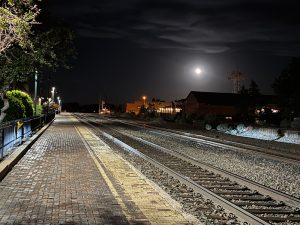
Like some of those folks, let’s say you’re starting your walk at Beaver Street, not that it matters much, but that’s the way that I often go when I am heading downtown or somewhere beyond from home. Either way you go you’ll be traversing just the two short blocks’ worth of railway platform that links Beaver and San Francisco streets.
It is a natural-born pedestrian’s terrain, no cars allowed, bicycles discouraged, though one of its appeals is of course the visceral excitement of feeling the rumor, the rumble and the roar of an onrushing freight whose rhythmic passage is heard and felt in equal measure. In fact at almost any time of day you’ve got a good chance of spotting a obsessed tourist, usually from some other land, set up with a tripod to capture the romance of the Santa Fe rushing by. Who says freight trains are mundane?
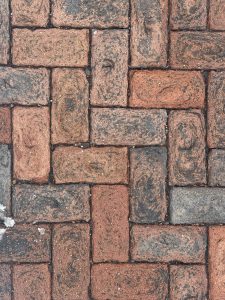 Take your stroll, then, straight east, walking almost the entire way on a herringbone pavement of soft reddish bricks. The word “reddish” here is a disappointing disservice to the bricks, many of which have become weathered with a rich dark desert-varnish patina of the sort that builds up only through years of sun and weather and foot traffic. Other vintage bricks, presumably worn down to unusability, have been replaced by newer ones, leaving a wonderful rag-tag pattern that looks lived-in, or lived-on, in the best way.
In fact one of the best things about the walk is that way in which it rewards looking in every direction, including down. I have sometimes gotten so caught up in scanning the bricks, in trying to imagine the incredible array of footfalls that have landed on each one—those of tourists, tramps, students, scammers, businessmen and dreamers—that I forget to look at anything at eye level.
And that is plenty rich too. Over toward the Beaver Street end, that’s where you’ll see the giant ten-foot-tall logging wheel, the simultaneously cumbersome and elegant device that was used decades ago to drag giant ponderosa logs out of the forest to some waiting train car. A mainstay of the economy back then, to be sure, and a reminder of how much grunt work was required to build the foundations of our current easy-fueled economy of convenience and instantaneous gratification.
Beyond it, the train station rears up. With its massive brick abutments and mock-Tudor half-timbered second story, it is the very image of metropolitan aspiration—fitting for a key city building stemming from the mid-1920s, when the importance and romance of cross-country train travel were perhaps at their peak. In the very same year the station opened, 1926, Route 66 was inaugurated just on the other side of the building, most of its road-jarred travelers little suspecting how the central role of the railroad in American life would be reshaped in coming decades.
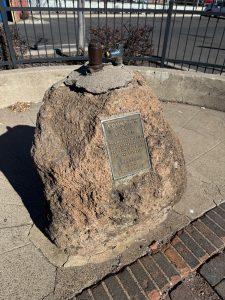 Keep going. East of the station, the sky opens up, as if foreshadowing the vast open spaces of the Great Plains (or even the passage to Winslow) that lie to the east. The steel fence that encloses the platform curves outward to accommodate a large boulder that back in the day was repurposed into a public drinking fountain. Remember those? It is bittersweet to envision a parched traveler bending down to sip from what was billed as the “Fountain of Youth,” “99.6 pure” water “from eternal snows of San Francisco Peaks in the distance”—not only because drinking fountains are one in a long list of public conveniences that have given away to the privatization inherent in for-sale plastic water bottles, but also because the seemingly eternal snows on the Peaks have given way to seemingly eternal sun and fire danger.
But this is exactly the sort of thing that makes for a great walk—the contradictions inherent in historical layering. These two short blocks don’t point back just to the wistful romance of clacking train travel, but also to the complexities that arise from what we’ve long seen as the human need to get around, fast. The least we can do is to take the time to appreciate them, even if only on a short detour on the way to somewhere else.