 There must be a Norwegian proverb predicting luck or misfortune for anyone caught in a flooding event in New York City and thereby missing their plane to Oslo. My father drove and swore as the station wagon kicked up plumes of rainwater along the highway-turned-river. If it was misfortune that the plane had departed when we finally arrived at Kennedy International Airport, it was luck that another flight, almost empty, would be departing two hours later. Would I care to be on it? I would! And with those two words I was issued a ticket.
Thus, I arrived in Norway well-slept (spread across five empty seats) and, thanks to a Norwegian-English dictionary I’d tucked into my pocket, newly able to say Good morning! and Where is the bus stop? and Is there a fjord nearby? It would have been helpful had I been able to say, Hello, I am a high school student from the United States and I have signed up for an exciting summer of working on a farm in the north of your country where the sun never sets and therefore the work never ends. And yes, it did sound like a good idea when my mother found the ad in a glossy magazine, and I expect everyone speaks English because doesn’t everyone speak English? And now, though I can ask the whereabouts of the bus stop, I am not sure where the village of Lauvstad actually is and whether it can be approached by bus. Do you know any proverbs?
I don’t remember how the next leg of the journey unfolded, though I do remember a bus from the small city of Alesund and the strange sensation of sitting beside a young woman who looked just like me. For all these years I’ve remembered her name: Madeleine Fanemel. In the extremely tiny village of Lauvstad, Johannes Flotre and his wife and three small sons stood in a cluster, shifting nervously as the bus doors opened. What would the American look like? Would she be tall and strapping like all Americans? Would she require certain conveniences or luxuries they couldn’t provide? And of course she would speak Norwegian, wouldn’t she? Surely the advertisement in the glossy magazine made it clear that when in Norway, people speak Norwegian. Needless to say, it was an awkward beginning.
Norway has a distinct and watery beauty found nowhere else on earth. The mountains fall right down into deep fjords, leaving little room for towns or farms. Everything is precariously balanced on an edge. The farms are tucked against the mountains and the summers are short though the days are endless. The Flotre family grew grass all summer to feed their cows all winter. The cows were let loose to graze in the mountains after the snow melted in late spring, then in the early fall they were herded home before the snow started up again. The whole operation was about loading up the barn with hay and filling the silo with rich Norwegian grass. Johannes had a BM Volvo tractor (he always called it by its full name), of which he was understandably proud. He mowed the fields and his wife and I did the hesjing (I’ll explain). The grandfather in the family tended a large plot of potatoes and we all kept an eye on the kids.
Hesjing is basically a practice of hanging freshly mown grass on a line to dry. Imagine fields strung across with laundry lines, but instead of sheets and shirts and trousers flapping in the wind, it’s grass, long Norwegian grass. Watch the two women, Ingfrid Flotre and me, standing before the lines, large messy handfuls of grass in each hand, whipping our handfuls vigorously up and down to make them more, well, foldable, then folding the grass across the wires. The wind will dry it out in a few days and we will come back and collect it. Of course, if there’s rain, which there often is in that part of the world, it will take several days to dry but at least it won’t rot on the ground.
This, you could conclude, was my summer, a summer of hanging grass. We worked all day until nine in the evening, though the evening was indistinguishable from any other time of day. I was truly in the land of the midnight sun. We ate huge amounts of waffles and dried meats and cheeses and something called sour milk which was indeed sour milk but tasted more like a delicious yoghurt. On Sundays we had a day off and we spent it visiting family around a couple of fjords. Johannes drove. Ingfrid sat in the passenger seat and I sat in the back with the kids. The car, for economical reasons, had only a windshield and two side windows up front. From where I sat, my view of Norway was mostly the back of Ingfrid’s head and Johannes’s hat.
The grandfather spent Sunday with his wife in town, across the fjord. She worked in a shop all week and we never saw her on the farm. At first, the grandfather and I had a relationship of mutual exasperation. If I ventured near the potato plot where he spent all his time, he’d get flustered and start talking quickly in Norwegian and pointing at this and that. It was then I decided to set myself the task of learning ten new vocabulary words a day. I scanned my pocket dictionary for anything having to do with potatoes, and ten words by ten words I was able to make my way into the older gentleman’s life.
Jostein, the three-year-old, was my other inspiration and teacher. By the time I was four weeks in, he and I could converse in full sentences. This, I finally realized, this was my summer. To meet people where they live, to speak with them in the language they speak, to ride with them in the cars they drive, and to sit and eat at the table with them after working hard all day in their fields. This was their gift to me, to open up their lives and make a place. I earned the equivalent of fifteen American dollars a week and brought it all home and spent it a few months later on a Norwegian class where the teacher couldn’t hide her surprise at my rural dialect. I sounded, to her ears, like the equivalent of a Norwegian speaking the American English of the Deep South.
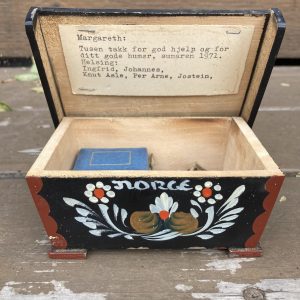
I didn’t tell her that the night before I was to leave the Flotre family and travel home, they presented me with a beautiful wooden box and asked me to tell them a story. They, like many Norwegians, were fascinated by American celebrities in general and the Kennedys in particular. They wanted the scoop on the recent Chappaquiddick incident and I, with hand gestures and just enough vocabulary to get by, was able to explain to them what happened, to the best of my knowledge. It was a test of my linguistic efforts and accomplishments, but more than that, imperfect as it was, it was something I could give back to them, an acknowledgement of our mutual dependency.
To bring home to America an understanding of interconnection and reciprocal goodwill was a nugget of gold and a lesson I wish upon every young person—upon everyone young or old. I wish us all the opportunity (which for many of us is rare), courage and curiosity to look beyond borders and stereotypes, to step into the unexplored. And there, I’m certain, we’ll come across the Norwegian proverb that instructs us in the art of becoming a citizen of the world.