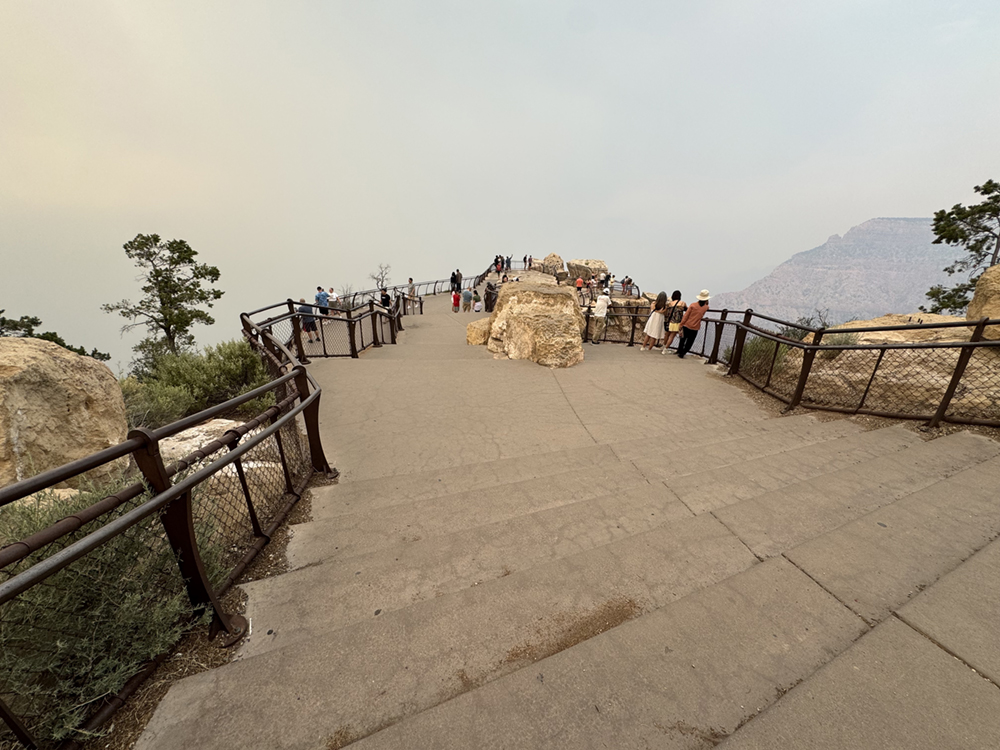
Mather Point, July 14, 2025
At first glance it was apparent that the Englishman was a far more serious cyclist than any of us. He wore a skin-tight body suit emblazoned with a heraldic red rose icon and the word “Lancashire” in huge letters. His bike was sleek, expensive, and immaculately outfitted with state-of-the-art panniers, and he had the slightly mincing walk that cyclists affect when they are strolling around in their hard-core, and hard-soled, cycling shoes.
“It’s something to see it like this,” he said, in words that only slowly revealed themselves to me as English; it sounded as though he was gargling with hard pebbles as he spoke. I wasn’t sure where Lancashire was, but it was clearly one of those parts of the Old Country where strong regional dialects live on.
He was gruff, a serious bloke. As was evident when I asked him where he’d come from that day. Flagstaff, he said, which was impressive to me because the four of us had spent an hour and 15 minutes doing a high-speed drive from Flagstaff to Tusayan, and then another half hour or so biking along the five-mile paved trail from the park-and-ride lot to the South Rim. He’d done all that by 4 in the afternoon. The next day, he was cycling on to Seligman, and from there to Las Vegas. It was not his first trip to the Southwest, he said; in fact it was his sixth. Which probably lessened the blow of the view from Mather Point—or the lack of a view, in a sense, because early last week standing on what is probably the South Rim’s most famous viewpoint was eerily similar to looking out from a mountaintop wreathed in clouds.
This had not been the plan. The plan had been to spend an idyllic five days cycling across the lupine-and-aspen summerlands of the Kaibab Plateau, riding and relaxing in the quiet, cool, and out-of-the-way surroundings that see only a fraction of the heavy visitation on the South Rim.
But it was not to be. Before we left Flagstaff we knew not only that the North Rim had been evacuated due to a fast-moving wildland fire that threatened the area’s only road access, but also that another fire directly on the rim had flared up and taken out, among other things, the glorious North Rim Lodge.
Things had happened quickly enough that the friend who’d organized the trip was still getting text reminders about our dinner reservation at the lodge as we neared Mather Point. At least we had another rim to explore, we figured, as we pedaled the last stretch of paved trail from the visitors’ center to the edge.
And there it was—the edge, that is, the limestone and concrete of the point enclosed in protective metal guardrails, inside them afternoon visitors taking in the view of . . . nothing, it seemed. What lay beyond the rim was almost entirely vanished in the smoke-haze. There was no North Rim, no river, just occasional hints of buttes and ridgelines far below that mysteriously hove into and out of sight as the smoke wafted this way and that. To the west, the sun burned yellow-orange, its high-summer force diminished.
It was fascinating and dismaying all at once. Most of these visitors, speaking a panoply of languages, had likely never been to the North Rim, had never experienced the smooth swoop of the long two-lane road in, or—better yet—the tingling exhaustion of hiking to the North Rim from the South and toasting the end of a long day with a sunset beer on the lodge patio. They’d never stayed in one of the rustic cabins, ears perhaps attuned to the sounds of mice in the walls, or fallen asleep among the tall ponderosas in one of the West’s more scenic national park campgrounds. Even if their plans had been disrupted, most probably did not have the memories in place whose existence made so painful the knowledge that some of the smoke blocking our view might be coming from the burned-out lodge and cabins and employee housing up there. And so they behaved as tourists on the rim always did, even if bemused by the unusually dim hints of the canyon’s geology and topography: talking, laughing, taking selfies set against the haze.
We spent the next four days on the rim, biking back and forth, marveling at the way the smoke moved in and out of the canyon, now cleared out by wind, now rolling down the drainages during a calm night so that the morning vista was netted by skeins of thick white smoke clouds far below us. We learned that buttes and temples only partly glimpsed through haze look far bigger than they do in full sun. We learned that on the most monsoony day that week, when the smoke plume arose strong and thick from the Kaibab Plateau, the very first small white cloud of the morning could poof out just above the smoke cloud itself, then swell and expand and shake loose its mooring before drifting off to the northeast. It did rain that afternoon—a lot on the South Rim, but only a bit on the North.
I’ve got the photos to record those views, and I had the sore muscles to document that we worked hard in getting ourselves to what seemed an endless array of vista points. But what I most took home with me was the encounters with the humans of Grand Canyon, the questing and generally friendly and funny visitors whose relaxed demeanor and refreshingly good-natured humanity served as a strong antidote to my own sorrows about the fire, and the far bigger ones about the awful fix our nation and world is in.
Like the Lancastrian cyclist. “I really feel for those on the other side who lost everything,” he said, crunchily. “My not bein’ able to see the view is nothing.”
Photo Caption: